
Chapter Three - FLYING FURTHER AND FASTER
THE DESIGN CONCEPT
The Pacific Flyer is a far cry from the popular image of a conventional hot air balloon with its gaily colored envelope and cosy wicker basket. The huge shimmering all silver envelope is 30 times the capacity of a regular 77,000 cubic foot sport balloon, and the high tech capsule ringed by huge tanks is full of complex controls and avionics more in keeping with one of Richard's Virgin airliners than a balloon. The intricate stack of twelve burners puts out enough power to run a fair sized town and the overall scene at launch is not far removed from a manned space shot.
The fully laden take-off weight of the capsule and tanks is seven and a half Tonnes with the envelope being an additional one Tonne. The massive external tanks weigh the best part of one Tonne each. So after they have been dropped, the landing weight of the capsule is a "mere" one and a half Tonnes. The design objective is clear cut: to carry two men across the Pacific in the jetstream and deliver them safely on the far side. Using the jetstreams automatically fixes many of the design parameters, such as cruise altitude, and crossing speed, hence the flight duration and fuel load. The takeoff weight determined the huge size of the envelope and the number of burners to heat it.
A trade-off had to be made between fuel consumption on a slow summer crossing with long hours of solar heating, and a fast winter crossing with less solar gain. Computer predictions favored the winter option, but even if they had not, the risk of summer thunderstorms and wandering jetstreams would have loaded the pilot's decision in favor of a winter attempt. The short daylight hours affected the envelope design concentrating it on heat retention rather than absorption. The fast winter crossing had the added benefit of reduced pilot fatigue although it was still a long, demanding journey with maximum alertness required at the end for the tricky landing stage.
SAFETY FIRST—LESSONS LEARNED
The capsule shell was identical in size and construction to the Atlantic one and the envelope similar, however, so many developments and improvements were built into the Pacific Flyer that it was really a new design. The following major safety features were incorporated as a direct result of experience gained with Atlantic Flyer and Stratoquest.
A substantial new launch pad based on a turntable set into solid concrete and doing away with sandbags.
Six individual tanks ratther than coupled pairs. This allowed far better access to the entry/exit hatch, and gave improved visibility through the windows, at the same time saving weight and complexity.
The tank suspension cables and guillotines were uprated to ensure that tanks would not break away.
The parachute vent was opened by duplicated hand-operated winches to control descent. This system was proven on Stratoquest and considered more reliable than a battery-operated elec- tric winch with no "feel".
Explosive guillotines were fitted to the winch cables to make sure the capsule could not "hang up" on them when the envelope was released.
Upgraded "Aerospace" explosive bolts were used to ensure release of the envelope on landing, to prevent a repeat of the Irish episode! The new bolts had duplicated firing circuits, and separate dedicated batteries.
More burners fed by less restricted fuel lines were fitted, the extra burn power would give greater control and braking effect during the landing approach.
The complete engine, compressor and alternator package was duplicated for greater reliability and life expectancy on the longer journey.
- — More powerful alternators were fitted to supply more electrical equipment and keep the batteries well charged.
- — Dome de-icing was developed to maintain visibility.
- — Radar altimeter fitted to give true ground proximity for landing.
HOLDING IT DOWN THE LAUNCH FRAME
The launch is a crucial part of the attempt. The conditions have to be perfect throughout the three to four hour inflation. Any wind in this vulnerable period could turn the gentle giant into a raging monster. When the weather gurus finally give the go ahead the balloon is laid out downstream of the prevailing airs (winds would be too strong a word) and the capsule lined up and tilted on its side. The envelope is then connected to the capsule ready for inflation. On inflation the balloon slowly rises and lifts the capsule upright in the launch frame which restrains it while all the final preparations and loading are completed. When all is ready the balloon is cut free to ascend into the heavens. Prior to the Pacific attempt, launch frames had been rather an afterthought hurriedly made up at the last minute, and augmented by sandbags to provide anchorage. Taking off with some of these sandbags was becoming a habit we wanted to break, so for the Pacific, a robust launch platform was designed to which the capsule was directly attached without sandbags.
The launch pad consisted of a turntable sunk into a concrete well and revolving on a heavy duty Volvo truck hub. On top of the turntable was hinged the tilting platform to which the capsule was attached with six tie down cables. This arrangement allowed the capsule to be aligned with the envelope and then tilted on to its side for inflation. As the balloon rose the capsule was lifted into the vertical position and locked down until take off. The tie down cables terminated in load cells which gave a readout of the total lift. When this reached approximately one and a half Tonnes the cables were simultaneously cut by explosive guillotines freeing the balloon to start its voyage. Old habits die hard so we provided Per and Richard with two miniature sandbags to throw out!
KEEPING IT UP — THE ENVELOPE
The huge iridescent silver balloon shimmering in the arc lights is not just a photogenic prop for the PR men, though they could scarcely better it. It is in fact a giant reflector keeping the heat bottled up inside like a gargantuan thermos flask.
The envelope is the lifting element of the balloon system, carrying the capsule through a net of load tapes running down to the mouth and terminating in flying wires from which the capsule is suspended. The lifting power is a function of the temperature difference between the inside and outside of the envelope and the volume of air displaced, equal to the envelope capacity. As there is a limit to the temperature the fabric can withstand (about 100°C is normal) the capacity is governed by the load to be carried aloft. In this case a capacity of 2.6 million cubic feet (74,000 ml) was to lift eight and a half Tonnes at takeoff.
The dimensions of the envelope were 51 metres diameter at the equator by 5 3 metres from mouth to crown. To give a sense of scale this has been compared to the diameter of the Albert Hall, and the height of Nelson's Column.
The envelope material held the key to success—or failure—of the project. The Atlantic envelope was silver above the equator and soot black below—this was to retain the heat in the hottest upper part and absorb terrestrial radiation in the lower, cooler area. The Pacific envelope was silver all over, designed for maximum heat retention during the long night hours. The material was laminated from ripstop nylon and bright aluminized polyester film. The nylon base provided the mechanical strength with a layer of polyester laminated to both sides. For further insulation, inflated "sausages" ran up the inside of each of the 36 vertical gores — like a quilted lining on the inside of a jacket. In the top of the crown is the "parachute vent" which is winched down to dump hot air for descent. The bottom skirt around the mouth is made of fireproof "Panotex" carbon fibre based material to withstand the burner flame.
The whole of this huge envelope weighs just over one Tonne and contains nearly 80 Tonnes of cold air. To reduce the weight of this air and provide the necessary lift, the inside air temperature would vary from about 90°C at take off down to 30°C at the end of the flight.
SPACE FOR TWO THE CAPSULE
The capsule is home for the two aeronauts suspended in their tiny bubble of processed air as they float like an inconspicuous dot high above the deserted Pacific Ocean. The shell is a conventional pressure vessel with a cylindrical waistband 8 feet (2.4 metre) diameter and mushroom shaped endcaps fabricated in aluminum alloy. The centre section is rolled and rivetted, while the endcaps are spun from great billets of plate like saucepan lids and welded on. The top cap has a 2 foot (586mm) hole cut out of the middle for a visibility dome, so the crew can keep a watchful eye on the envelope, the burners, and all the machinery that covers the top deck. Entry is through a hatch in the side, closed and pressure sealed from inside with a one inch thick honeycomb door. Five pressure tight aircraft windows "rescue" from a Jet Commander are spaced around the diameter to make a hexagonal platform about the door.
Finally the shell, with door, dome and windows in, was pressure tested to 10 p.s.i. (0.7 bar) to prove its integrity.
The inside of the capsule resembles the flight deck of an airliner, except that one of the pilots faces backwards! There is no nose or tail and as the balloon gently rotates the five windows provide all round visibility. Each pilot has a reclining seat behind a work station, with instruments, avionics, communications, and navigation aids. Crammed into every other available space are electric switches, firing buttons for tank and envelope release, camera controls and monitors, air system and heater con- trols, pressure regulation valves, oxygen equipment, emergency equipment, provisions, and little niceties like shark repellant. Overhead is an array of burner controls, and under the "fibrelam" crew floor are four propane fuel cylinders foamed into place to insulate and restrain them. These tanks hold the landing fuel for the final stages of the flight. There is room to stretch out on the floor between the seats for a shuteye between watches. An airlock "pee" tube acts as the toilet.
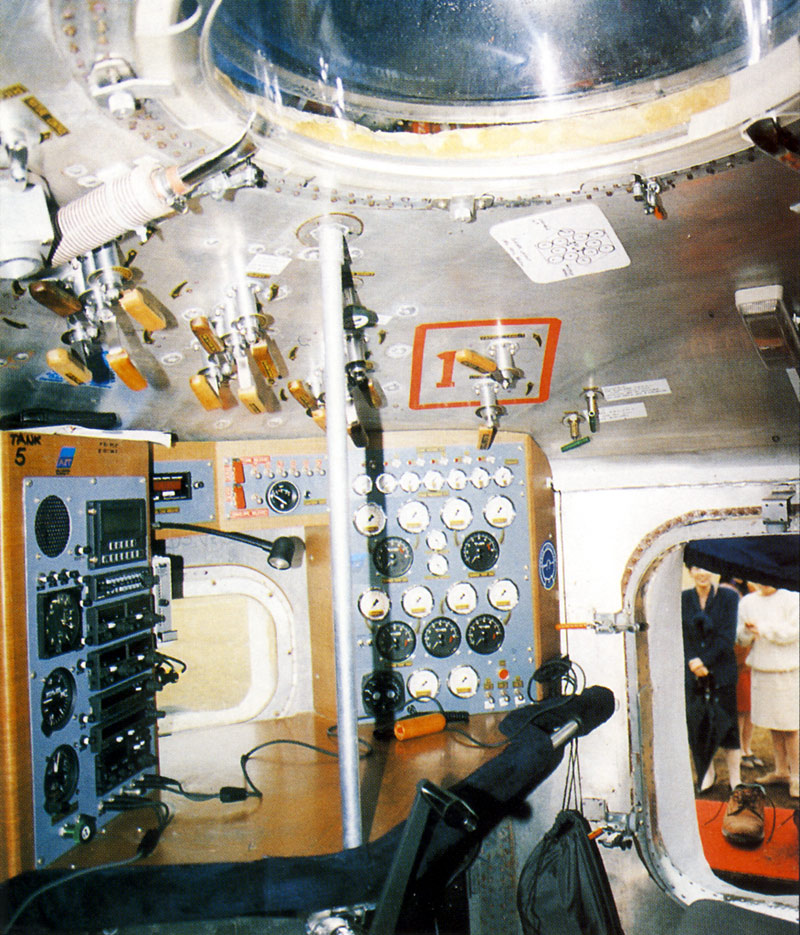
View from the hot seat, inside the Pacific capsule.
On the outside of the capsule the first item to be fitted was the landing frame. This was designed to collapse on landing to absorb energy, but of more immediate interest, it stopped the capsule rolling around like an egg so we could work on it. Bolted on top of the capsule is the load frame, a hexagonal tubular "crown" which connects the capsule to the envelope flying wires through split knuckle joints held together with explosive bolts—and safety pins.
Also suspended from the capsule half of the knuckle joint are the six external fuel tanks so their weight is carried directly through the knuckles into the flying wires and envelope.
On top of the load frame is mounted the burner frame supporting a cluster of twelve burners arranged in a hexagonal honeycomb pattern and hooked up to a complex maze of fuel lines, thermocouples and pressure toppings. Also perched on top of the load frame are the two pressure engines packages, each complete with its air compressor and alternator, and mounted onto a subframe which pivots out- board of the load frame. After final descent below pressure altitude, or in case of failure, the engine package can be unlocked and tipped overboard like emptying a wheelbarrow. Associated with the engines is a labyrinth of air ducts, silencers, intercoolers and valves, to control the air supply and temperature. To insulate the capsule and cushion landing impact, the whole capsule outside is encapsulated in polyurethane foam. The cylindrical centre section is covered in precut blocks which are shaped to cradle the external fuel tanks. The top and bottom are coated with sprayed-on foam.
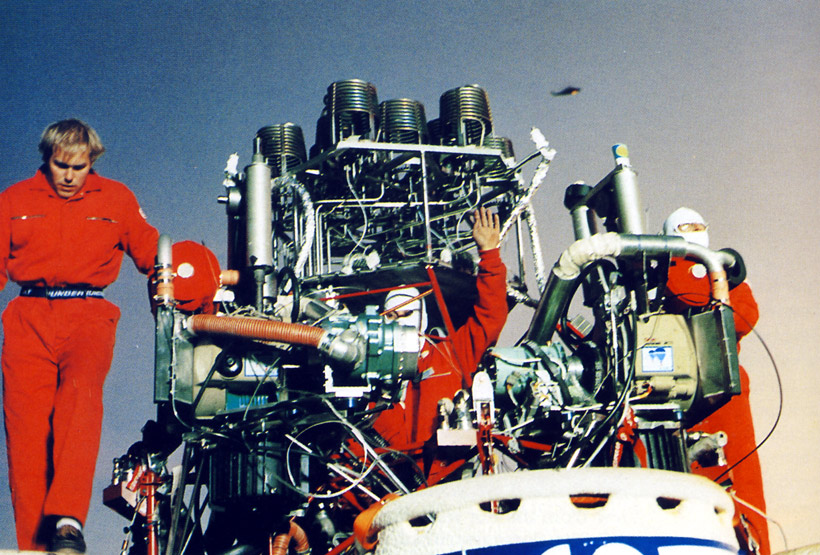
Machinery crowded onto the top of the capsule.
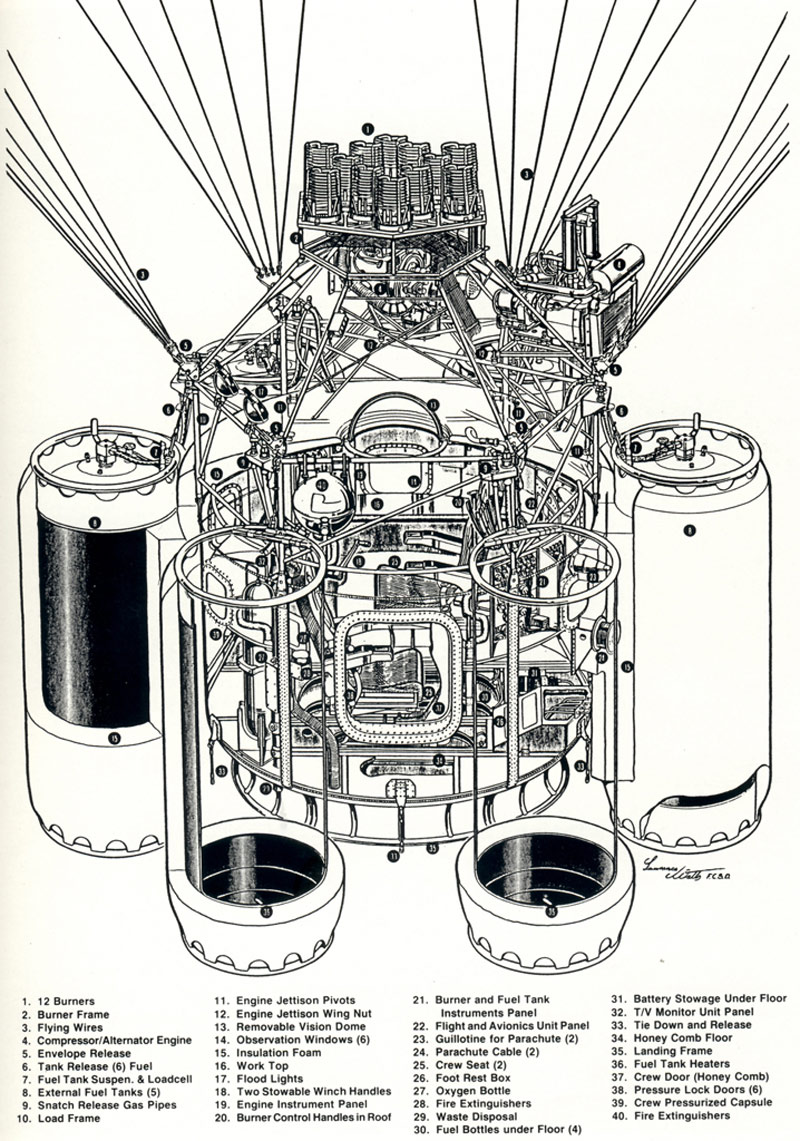
Cutaway drawing of the pacific capsule.
HOT STUFF — THE BURNERS
Testing the burners at night is an awe-inspiring spectacle, the noise and fierce heat making casual spectators recoil in alarm.
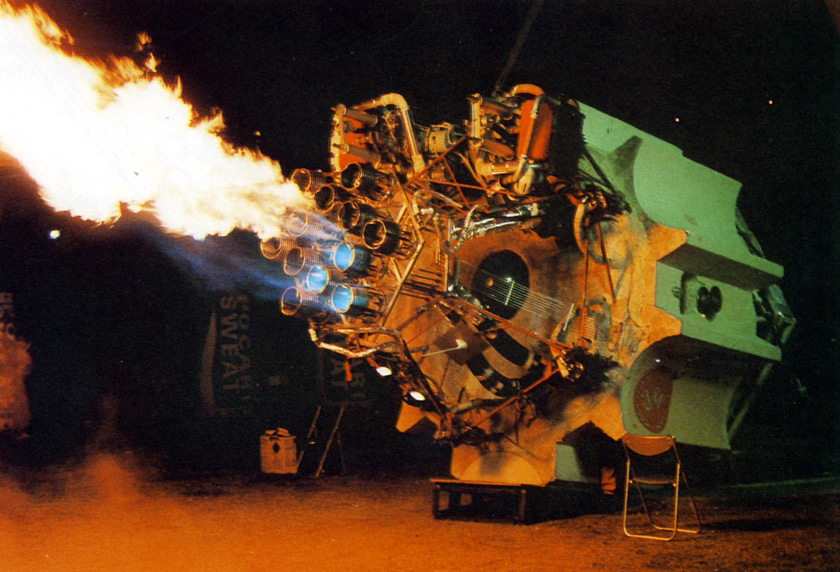
Burners in action
Pacific Flyer has a cluster of twelve vapor and four liquid fire burners capable of producing a massive 24 Megawatts. This tremendous output was not required for steady flight but for rapid response on climb out, or landing. The Pacific burners are based on standard Thunder and Colt units modified to operate at high altitude and tested up to 40,000 feet in the A.I.T. altitude chamber at Burnley. A fine mesh "melt down" screen is spread below the burner frame to arrest any molten drips before they hit the vulnerable perspex visibility dome, risking an explosive decompression.
BOTTLED ENERGY — FUEL AND TANKS
The energy that the burners convert so dramatically to hot air, has to be contained in fuel, lots of it. Enough to lift the capsule up through the cold dawn air and into the jetstream where the sun's rays rising over the Pacific horizon would supply the energy until the next nightfall when the burners would take over—and so on until the balloon reached America or the fuel ran out.
The fuel is liquid propane carried in pressurized cylinders. The bulk of it is carried in the six massive external tanks that ring the capsule. Each tank contains three quarters of a tonne at a working pressure of 8 bar (116 p.s.i.), a total of four and a half tonnes—or three times the capsule weight. The tanks are welded stainless steel cylinders 2.4m high and just under lm in diameter, weighing 170Kg each empty. Landing fuel is contained in four tanks under the capsule floor.
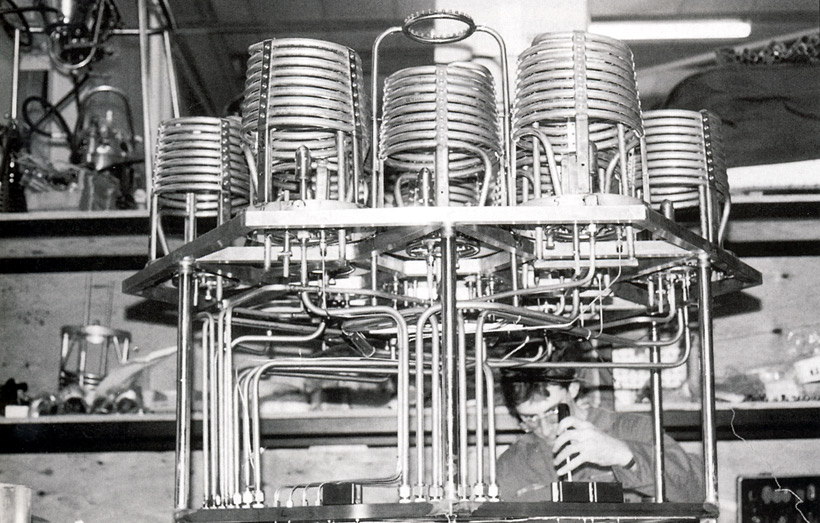
The burner stack being assembled.
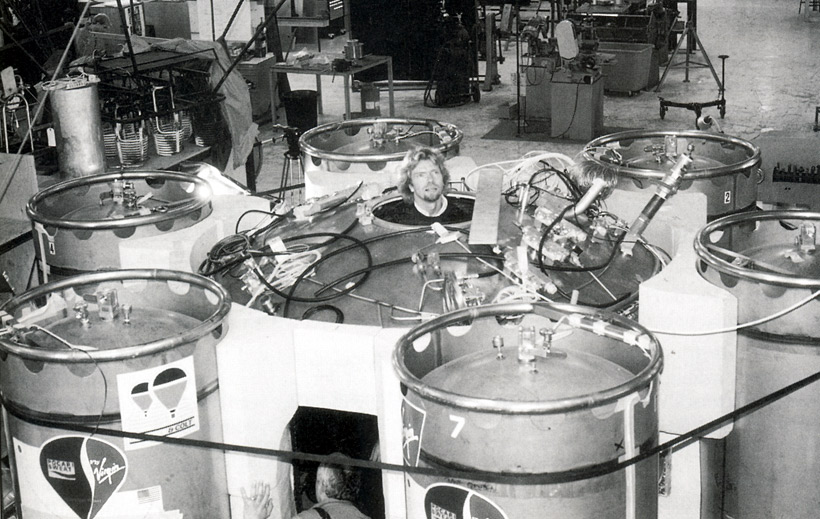
Richard Branson looks out over six fuel tanks.
To maintain fuel vapor pressure necessary to feed the burners the fuel temperature must be kept above freezing. To keep them warm the tanks are insulated with foam and electric immersion heaters are fitted to compensate for losses to the sub zero atmosphere.
KEEPING UP THE PRESSURE — ENGINE AND COMPRESSORS
The two pressure engines bring the capsule to life, pumping vital air and warmth into the cabin and generating electric power for all the avionics, and to warm the fuel. Each engine "pack" comprises an engine driving a compressor, and generator, all mounted on a common base plate, along with silencers and intercoolers. Both engine packs were identical, but independently mounted on their own jettisonable subframe. The engines were "all aluminum", two cylinder, aircooled "Onan'' units developing 20 b.h.p. at 3600 r.p.m. They were converted to run off propane to use a common supply with the burners. The 24 volt 90 amp alternators are directly driven from the engine shaft through a straight coupling. The compressors, however, have to rev right up to 12,500 r.p.m. to provide the 4.5 to 1 pressure ratio required for the capsule at 40,000 feet. To gear the engine revs up, a Gates "PolyChain G.T." toothed belt system was selected to cope with the high speed and cold conditions and give high reliability for a light weight. Pulleys are used to give a step up ratio. The compressor was needed not just for the cabin pressure but also to supercharge the engine and keep it running at high altitude, where it would otherwise peter out through lack of oxygen.
Finding a suitable compressor was not an easy task — and certainly not a lightweight one! Eventually, Alex settled for a Broomwade Compair Unit which gave just the right, oil free, performance but re- quired many hours whittling away at the casing with a milling machine before the weight was acceptable. The success and safety of the project depended on the engine and compressor running night and day without a pause. To prove the system it was tested in the A.I.T. altitude chamber, and subsequently run for 100 hours on test.
The output air from the compressor is fed into the capsule interior through silencers, to stifle its horrendous howl, and an intercooler to control its temperature. An aircraft cabin regulator valve con- trols the pressure to the selected level venting the excess overboard. This "open loop" system as used in airliners not only keeps the capsule at constant pressure but provides a through flow of fresh air, purging out the carbon dioxide and humidity breathed out by the pilots.
LIVE WIRES — ELECTRICS
We live in the electronic age with ever more sophisticated, capable and compact systems being introduced. Pacific Flyer was no exception. For example, the television cameras and recording equip- ment weighed only one sixteenth of that in the Atlantic Flyer, yet were more advanced.
The "electrics" umbrella covers a wide range of equipment and systems including: batteries, generators, avionics, communications, navigation, autopilot, instrumentation, load cell readouts, explosive releases, video cameras and recorders, burner ignition, etc., etc. Miles of cable and thousands of connections are involved and each circuit has to be identified, and tested.
Compared with the trackless thousands of miles of ocean below, the Pacific balloon is a mere pinprick and could easily vanish without trace were it not for navigational aids, and radio communications. These are the aeronauts' lifeline to the outside world, precisely locating their position, and relaying it to the control centre, who can also pass back vital information on weather conditions ahead. The Canadian Marconi "Omega" navigation system will be used to give the pilots their "fixes" and speed. In addition, Argos transmitters will relay fixes on the balloon position to the control centre via satellite.
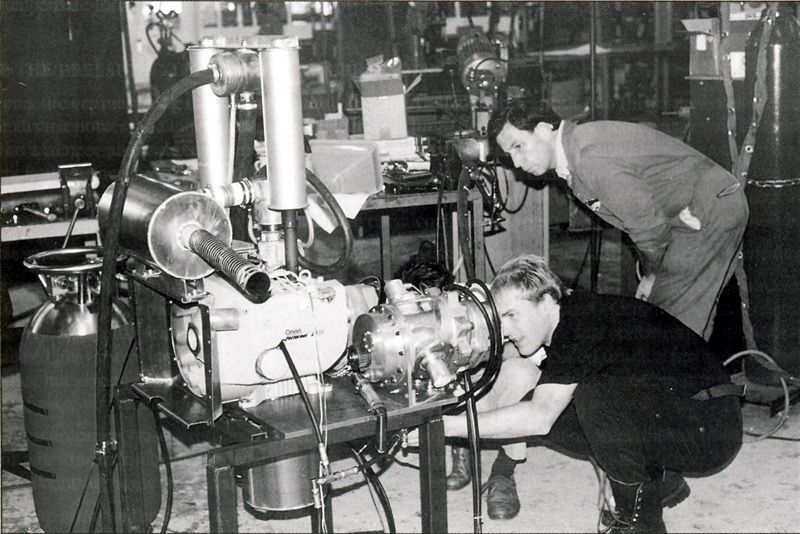
The engine and compressor being set up for test by Jo and Dewi.
LAST RESORT — EMERGENCY EQUIPMENT
There are no guarantees of instant or uneventful success with a project so adventurous and complex as the Pacific crossing. Success depends on so many factors; human, technical, and natural. One small defect is enough to bring down the balloon. To cater for all foreseeable contingencies a whole range of emergency equipment is carried, and rescue procedures established. Personal emergency packs carried, and rescue procedures established. Personal emergency packs carried by each pilot include:
- — Parachute — Strobe light
- — Liferaft and lifejacket Provisions
- — Emergency Location Transmitter - E.L.T. Medical Supplies
- — Flares Snow suits
The most obvious emergencies are depressurization, fire, and running out of fuel.
In case of pressure loss, masks would be donned with three hours' oxygen supply for both pilots available. This would allow time to descend to lower altitude. In case of fire, masks would be donned and extinguishers used. The unlikely event of a drastic fire or structural failure at altitude could mean baling out with liferafts and emergency provisions.
Lack of fuel would mean a premature ditching in the sea. In this case, the envelope would be released and the crew would stay with the capsule, kept afloat by its foam cocoon. The Argos satellite beacon and emergency location beacons would transmit the position to the alerted search and rescue services. Water dye, flares, and strobe lights would home them in.
Next Page


