
Chapter Four - THE FIRST ATTEMPT
THE INFLATION
On Friday the 24th of November, 1989, the weather forecase looked good and all our preparations were completed. The time had come to unpack the envelope from its container. It was a case of all hands on deck as the huge canopy was unravelled and emerged on a chain of human shoulders like a great iridescent silver caterpillar with red legs. The envelope was stretched out with the mouth and flying wires facing the capsule and the crown 80 metres away down wind. It was then spread out on the ground sheet, and inspected. Sharp eyes spotted some "lifting" lifting" of the silver film at the edge of creases where the material had been folded. These defects were patched with spare material and double sided tape.
As evening approached the capsule was laid over on its side in the inflation position and the burners tested, fueled by the spare No.7 tank for ground running. The flying wires were connected to the top of the explosive knuckle joins, ready to haul the capsule upright when the envelope rose. Preparations continued into the darkness under a battery of floodlights. At 20.00 hours the count- down was put on hold due to doubts about the conditions. At 22.30 the launch was cancelled due to the steady down draft flowing down the hillside and over the launch arena. At midnight, in a sharp frost, the envelope was rolled up, and we finally hit the sack in the early hours. Preparations carry on into the night.
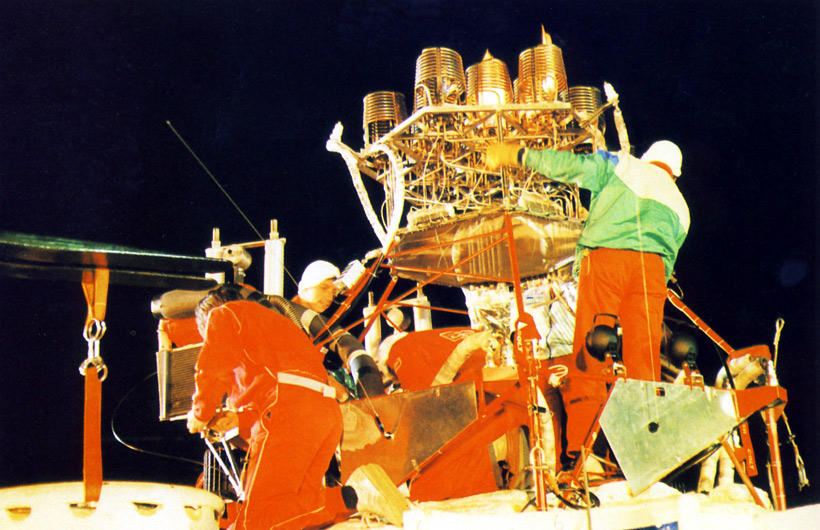
Preparations carry on into the night.
Saturday, the 25th, and the weather was again promising. Preparations proceeded in warm sunshine.
At 16.00 the weatherman gave the go ahead and the launch sequence began. The envelope was spread out again, but in places it had stuck to the ground sheet tending to peel the coating away. These areas were carefully released and patched, but sneaking doubts about the material were arising.
By now word had got around that the launch was on and more and more spectators lined the banks and stands around the arena, hundreds of families with children stood and watched in awed silence as we worked away into the darkness and increasing cold. Shorts and tee shirts were replaced by Nomex fireproof overalls and thick Thunder & Colt jackets. Fireproof balaclavas and gloves were welcome for warmth as well as fire protection. The weather held with absolutely still but freezing con- ditions, and the inflation went smoothly ahead.
First, the cold inflation: the mouth was held open while four powerful fans were directed into it, and the limp, lifeless envelope writhed, and slowly filled enough for crew members to walk around inside to inspect the envelope and connect the parachute rip lines.
In this case, the inspection took far longer than expected for, as the envelope pulled away from the groundsheet, areas of film peeled away and more and more patching was needed. It was a long and very cold inflation for the crew members standing for three hours holding the mouth open and flying wires clear in the icy 40 mile an hour gale set up by the inflation fans. At long last, the patching was done and hot inflation started. Hand held burners were carried into the cavernous belly of the balloon and the flame directed around in short bursts. As the envelope filled, the burns became longer and the burner man retreated to the mouth. Now the balloon was assuming a teardrop shape and the main burners of the prostrate capsule took over, shooting sharp stabs of flame into the gaping mouth.

The capsule laid over into the inflation position.
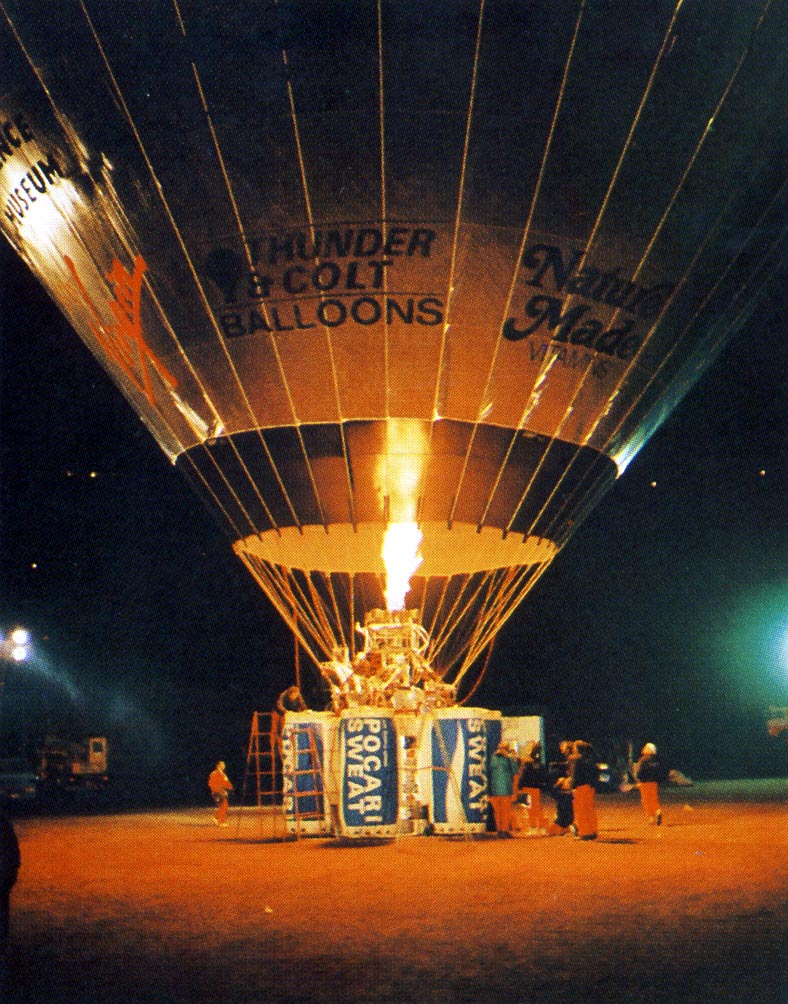
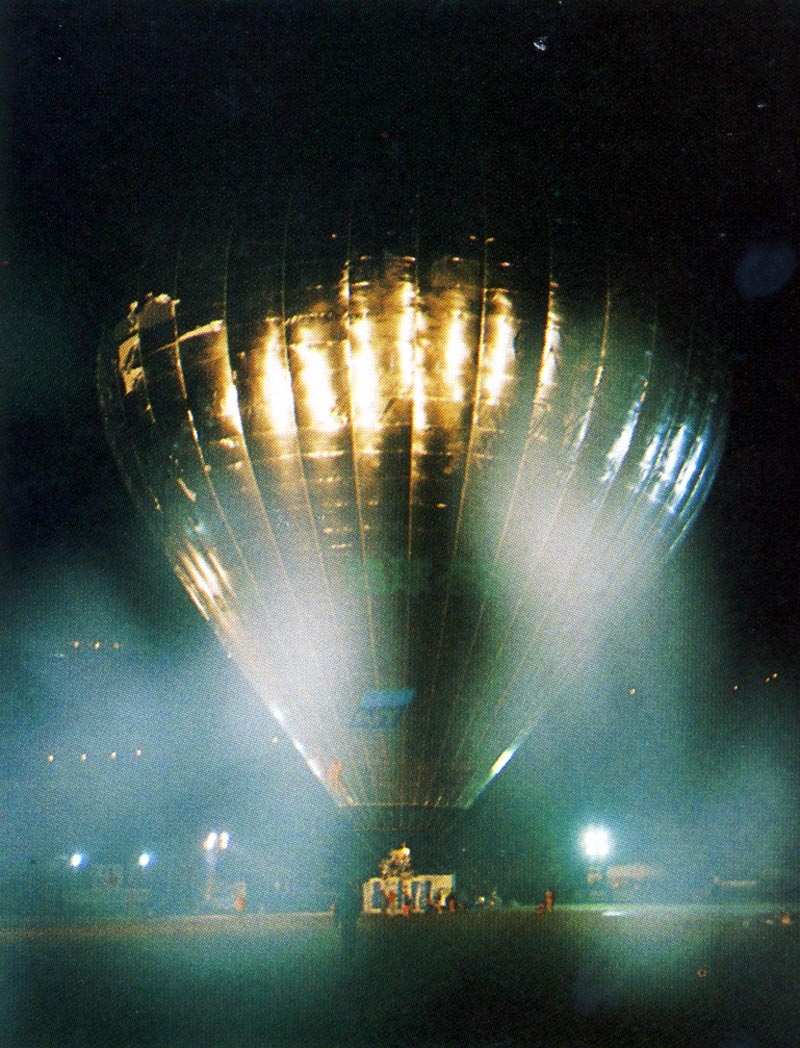
The scene had the atmosphere of a surrealistic play. A thousand oriental faces watched motionless in the bitter cold blackness that surrounded the arena. In the centre, as if on a giant stage the red overalled crew acted out their well rehearsed parts under the glaring spotlights. The centerpiece was the snow white capsule with its glittering crown of pipes and burners breathing fire. The massive external tanks loaded with propane stood back like a ring of motionless sentries. The backdrop was the great shim- mering silver balloon, filling the horizon as it slowly billowed and rose effortlessly lifting the capsule upright onto its turntable.

The arena was like a stage set as the crew acted out their parts under the glare of floodlights.
The arena was like a stage set as the crew acted out their parts under the glare of floodlights. A perfect inflation — the balloon stood rock steady over the capsule, fading into the darkness above the reach of the arc lights. An occasional burst of fire kept it filled ready for the final countdown to launching Per and Richard off to America.
DEFLATED DREAMS
The team set to like an army of red ants, loading the big external tanks with forklifts, while the engines were filled with oil and run up, adding their cacophony to the intermittent roar of the burners. However, all was not well with the envelope, the internal pressure of the hot air was accelerating the peeling, with patches of film lifting like skin off a sunburnt nose. This would not affect the strength of the balloon as the base fabric was still intact, but the big questions were:
- How much of the insulating effect could we afford to lose?
- How much fuel would the increased porosity cost us?
Like a dream, we could not believe our eyes, and expected to see a pristine balloon the next time we looked up — but no, there were the tattered edges, and even a patch of light where it had lifted both sides! As the discussions continued, more heat was applied to take the weight of the fuel tanks as they were loaded. The launch frame loadcells told us we had 480Kg — nearly half a tonne of life on the pad—if we fire the guillotines now and cut the tie-down cables, she would be up and away—albeit without a crew, who were now standing anxiously by, looking up instead of preparing for flight. The next moment the decision was made for us. A large piece of film detached by the extra pressure came floating down and neatly gift-wrapped the burner stack. The pilot lights set it alight and burning drips fell onto the insulation which started to catch. Jo Hanson was on the spot and quickly stamped them out. Ringed by a wall of propane tanks, the situation could soon have turned nasty!
With still perfect conditions, the parachute was winched open and the balloon deflated, collapsing gently to one side of the capsule and looking like a beached whale silhouetted against the first pink flush of dawn.
However, the envelope was still half full of trapped air, and the rising sun combined with the morn- ing winds could turn it into an uncontrollable monster, so we slashed the envelope open like blubber cutters and released the trapped pockets of foul smelling hot air, and watched the carcass sink and die. After 30 hours of drama it was just another fine peaceful day in rural Southern Japan. All the locals who had stayed and watched and wept for us had gone home with their private thoughts. Our Japanese friends and helpers were devastated. Sheer exhaustion prevented any overt display of emotion among the team, we knew the risks and chances, we would learn our lessons, and come back again better armed. If it was easy, someone would have done it already. That's record breaking! The die was cast, we could not fly without an envelope so we got busy, dismantling, emptying, making safe, protecting, and packing up camp.
That night we drowned our sorrows.
THE AFTERMATH
The press had got a story even if it was not the one we had wanted.
The capsule was ready to go and unharmed, it could remain in Japan.
The material failure would be analyzed, and measures taken to get the next batch right. A new envelope could be made to the existing design, but not in time to catch the winter jets. There would have to be a year's delay to winter 1990 to catch the jets at their prime.
There was talk of air drainage currents on the baseball arena, and discussion about moving to the flood plain below. However, we had found a weather window so the site was not totally unsuitable. The team would break up until the next time and get on with their lives, but most would suffer withdrawal symptoms. In success or failure the abrupt end of these high pressure projects leaves a vacuum, suddenly there is no burning obsessive goal, no camaraderie, no banter, no job — a distinct sense of flatness takes over—until the next one!
A JOB TO FINISH
If at first you don't succeed, try and try again. Never is this truer than in record breaking. We had to go back and try again armed with a bit more experience, and a few more lessons. Who knows what new pitfalls or obstacles lay ahead? But overcoming them is what it is all about. Our objective was simple: "to fly the Pacific and land safely on the other side".
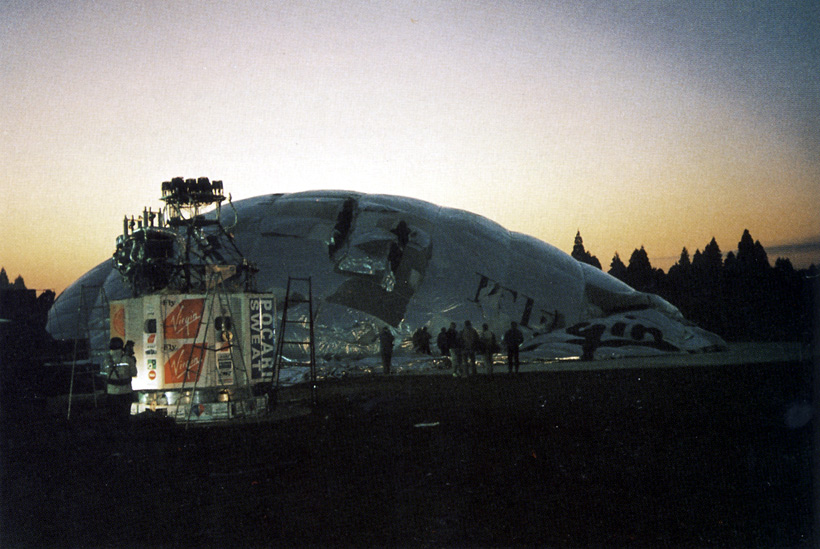
Like a beached whale, the deflating balloon is silhouetted against the rising sun.
Next Page


