
Chapter Two - CHOOSING A BALLOON
HOT AIR OR GAS?
The exponents of both camps are still battling it out as they did in the first days of ballooning. In everyday sport and pleasure flying the hot air balloon is almost universal, due to its portability, convenience, speed of inflation and controllability. Also, propane is much cheaper and easier to obtain than helium gas.
For record breaking, however, where the cost is high in any case, and the ultimate performance is the overriding criterion, the pros and cons are much more hotly contested.
GAS BALLOONS
The gas balloon gains its lift by inflating the envelope with a lighter than air gas, notably hydrogen or helium. Helium is almost universally used due to its inert non-flammable properties. Hydrogen was responsible for some of the world's most spectacular disasters such as the Hindenburg and R101 air- ships in the Thirties, so has passed from favor. As the balloon contains a fixed amount of gas, ascent and descent has to be controlled by either dropping ballast to ascend or venting gas to descend. This means that the balloon has to start out with a surplus of ballast, and each maneuvre costs a permanent loss of gas or ballast. On long flights this effect is exacerbated by the day and night effect. During the day the gas warms and expands and either the balloon pressure will increase (as in a superpressure balloon) or gas must be vented. Conversely, at night the now diminished mass of gas will contract and the balloon will sink unless more ballast is dropped. This depleting procedure will be repeated with each successive day. Rapid response can only be achieved by dumping significant quantities of gas or ballast, so in an emergency, nothing is spared.
The lift per unit volume from helium is considerably greater than that obtained from hot air at manageable temperatures, so the gas envelope is much smaller for the same load. Also, the weight of ballast is less than the fuel required for a hot air balloon for an ocean crossing. This is illustrated by comparing the Pacific gas balloon "Double Eagle V" with the hot air "Pacific Flyer". The Flyer's envelope is almost six times the capacity of the Eagle's.
SUPERPRESSURE BALLOONS
The superpressure gas balloon has been proposed for ultra long distance flights as it has advantages over the conventional gas balloon. The volume of gas is set to fill the balloon at the selected altitude and coldest night time temperature, daytime warming of the gas is accommodated not by venting but by allowing the pressure inside the balloon to build up and containing the stresses set up in the envelope fabric.
The benefits are:
- Saves gas and ballast as there is no diurnal venting.
- The envelope maintains a constant size (displacement) and mass of gas and therefore floats along at a constant altitude.
The penalties are:
- The envelope is highly stressed and therefore heavier. Fabric failure would be much more dramatic than in a conventional balloon.
- The increased pressure leads to increased leakage through the fabric.
On the 11th of January, 1991, only five days before the Pacific Flyer was launched, Fumio Niwa took off from Japan to attempt a solo crossing of the Pacific in his superpressure balloon, but suffered envelope rupture after six hours, coming down in the sea. Despite the fact that he was spotted uninjured and only 300 miles offshore, he was not picked up until the following morning when he was found dead from exposure. A sad tale, with lots of unanswered questions.

A superpressure balloon. This scaled down prototype of the Endeavour project set numerous class records on a flight over Australia in November, 1884.
HOT AIR BALLOONS
The hot air balloon relies on burning fuel to heat, expand, and reduce the density of the air in the envelope to provide lift. The fuel in general use is liquid propane in pressurized cylinders. This is burnt in "gas burners" with heating coils that vaporize the fuel before it is sprayed through jets in the burner rings, that are quite similar to those of a household gas cooker. The quantity of fuel carried depends on the weight to be lifted and the flight duration. On long distance flights a large portion (up to 60%) of the take off weight will be fuel. Carrying ever more fuel results in a bigger envelope and more fuel, and more weight, producing a classic case of diminishing returns — which is where the solar gain counts. The hot air balloon is much more controllable and responsive than a gas balloon. It is a case of "burn" to ascend, and open the "chute" vent to descend.
This controllability is the biggest single advantage of the hot air balloon for ultra long distance flights. It means that the pilots can seek out the core of the jetstream and stay there, as proved on the Atlantic crossing. The Pacific jet was even more fickle and the balloon required constant fine control manipulation to stay with it. When the jetstream forked two thirds of the way over the Pacific, the "Flyer" had to drop from 27,000 feet down to 18,000 feet and back up again to pick up the desired northerly branch — this maneuvre would have been well nigh impossible with any other type of balloon. The hot air balloon can also make maximum use of solar heating without venting precious gas, which means little or no fuel has to be used in peak daylight hours. As fuel is consumed the empty tanks are jettisoned and the balloon becomes lighter, requiring lower envelope temperatures to lift it and the fuel consumption is progressively reduced.
At a high altitude the balloon becomes more responsive because the air is thinner and less dense, so the weight of air in the balloon falls. For example, the inertia of the inflated Pacific envelope falls from 78 tonnes at sea level to around 24 tonnes at 36,000 feet.
The hot air balloon has a big bonus when flown with a pressurized capsule, in that the burner fuel can also be used to drive a warm air cabin pressurization system, and electric generators. This neatly sidesteps the problems of a spacecraft type closed loop air system and provides on-board condi- tions similar to those of a modern jet airliner, enabling the crew to survive and function in comparative comfort at jetstream altitudes without oxygen masks. The "waste" heat from the drive engines is not wasted at all but is directed up into the envelope where it contributes to the lift.
The Atlantic Flyer proved that a hot air balloon could use the jetstreams to fly faster than ever before. The Pacific Flyer extended the principle to set completely new standards of speed and distance by which all future flights will be judged, travelling faster than the top speed of most light aircraft. Ballooning will never be the same again!
PROVING THE CONCEPT
EXPERIENCE COUNTS
The Pacific Flyer was not conceived from scratch but drew heavily on Thunder & Colt experience from its previous record breaking hot air balloons, notably "Virgin Atlantic Flyer" which crossed the Atlantic in 1987 and "Stratoquest" which broke the altitude record at 65,000 feet in 1988. The Pacific Flyer is an extension and refinement of both the long distance and high altitude capabilities of its predecessors and was developed to avoid some of their more ''hair raising" aspects.
FLYING FASTER — THE VIRGIN ATLANTIC FLYER
The Atlantic Flyer successfully cross the Atlantic from Sugarloaf in Maine to Limavady in Northern Ireland. The flight took place on July 2nd and 3rd of 1987, the cruise altitude was 27,000 feet and the flight of 3075 miles took only 31 hours 41 minutes, with an average speed of nearly 100 miles an hour. This historic crossing proved the validity of harnessing the sun's energy for lift, and the jetstreams for speed, far exceeding the wildest expectations. The crossing was so quick that only a fraction of the predicted fuel load was required—fortunately, as one of the big external tanks broke free on takeoff. A milestone and breakthrough in long distance ballooning had been made.
The flight, however, was not without its dramatic and dangerous moments from which pilots Per Lindstrand and Richard Branson were fortunate to escape unharmed. After a perfect inflation in totally still conditions, the adventures started at takeoff. One of the six pairs of massive external tanks broke free on lift off and one of the packs of sandbags used to anchor the balloon down was carried aloft. Fortunately, the fuel was not required, so the loss of its weight was a benefit, and Per was able to cut the bags free with his trusty Swiss army knife. The risk of tanks full of volatile pressurized propane falling at the feet of the ground crew is one to be avoided in the future. The balloon climbed rapidly to its cruise altitude of 27,000 feet, and apart from a cold front, an overdose of solar gain, an overnight passage, and a few sonic shocks from Concorde, the flight was comparatively uneventful, reaching a maximum of 144 knots (166 mph) and breaking all the hot air speed and distance records.
The real fun was to start with the landing. Descending over Ireland to jettison the three surplus full fuel tanks, the balloon broke through the cloud cover at about 2,000 feet with Limavady ahead. The huge balloon with the massive intertia of its envelope was cumbersome and slow to respond to the burners, and its first contact with the continent of Europe was heavy. The three remaining tanks broke free, instantly relieving the balloon of two and a half tonnes of weight. The lightened balloon shot back into the sky and headed North for Scotland and some unpleasant weather. The next contact was half a mile out into the Irish Sea. Per fired the explosive bolts to release the uncontrollable envelope- nothing happened. The activating battery was flat. Per jumped from the careering capsule into the sea. and the lightened balloon took off again with Richard on board, and climbed high into the sky. With Per in the water and Richard in the balloon, it descended for the third and final time and Richard was plucked from the water by helicopter. Only then could he tell his rescuers that Per was in the sea, leading to his rescue.
The two soaked and frozen adventurers had made it across the Atlantic into the record books — but only just.
They had proved that a pressurized capsule allowing them to fly high was the key to success, in fact they had enough fuel to have easily flown another day and reached Siberia! They also learned some lessons the hard way, prime among them:
- — Finding an alternative to sandbags for anchoring the balloon down.
- — Stronger cables for attaching external fuel tanks.
- — More burner power to control descent and cushion landing.
- — Highly reliable explosive bolts to detach the envelope.

Virgin Flyer trailing its capsule in the Irish Sea.
"FLYING HIGHER" — STRATOQUEST"
Stratoquest climbed into the pink and blue Texas dawn on June 6th, 1988 to become the world's highest flying hot air balloon, at just 3 feet short of 65,000 feet. She was piloted by Per Lindstrand and built by his trusty team at Thunder and Colt in Oswestry.
The launch site was the Callahan Ranch near Laredo in Southern Texas. The tremendous hospitality of the ranchers and their five beautiful daughters was not the only reason for selecting the parched, flat, cactus, and mesquite thorn scrubland of this southernmost area of the U.S.A.
Incongruously, the temperature at high altitude is coldest in the tropics. This is because the tropopause is higher than in the temperate zones, so the temperature keeps on falling until a higher altitude. At the Laredo latitude it falls to about minus 70°C at 40,000 feet. Cold outside air is a bonus to a hot air balloon as its increases the difference with the hot air inside, creating more lift. The location offered other attractions; calm low and high altitude conditions, little air traffic and a virtually un- populated flight path with few power cables. An aerial recce of the expected flight path was, however, rather daunting; endless miles of vicious mesquite thorn scrub and prickly cactus, not to mention the rattlesnakes. We prepared ourselves for a nasty retrieve to extricate pilot and balloon from that forbid- ding terrain.
We had set a target of 65,000 feet to beat the existing record of 55,034 feet set by Julian Nott in 1980. This entailed climbing up into the rarified "near space" atmosphere above 60,000 feet where the outside pressure is so low that no oxygen can be assimilated, and the blood would boil, and where the outside temperature would be 70°C below freezing. At this altitude not only the pilot but the burners suffer oxygen starvation.
To overcome these high altitude hazards, the plan for success rested on three cornerstones:
- 1) A pressurized capsule with life support systems to keep the pilot alive for a short duration flight.
- 2) Specially developed burners and fuel to keep the flame alive.
- 3) Specially developed envelope material to maximize solar heating.
The single man Stratoquest capsule was tiny compared with the Atlantic one, at 3.6 feet diameter by 5 feet high, there was just enough room to squeeze Per and the equipment in. The capsule was to be pressurized to an altitude of 25,000 feet by the simple expedient of putting the door in at this height on the way up, and letting the falling outside pressure seal it. Pressure could be topped up or increased by releasing nitrogen from a compressed gas bottle into the cabin.
Due to the short duration of the flight, Per was to breathe pure oxygen from a mask and pressure cylinder with six hours supply. The use of pure oxygen allowed reduced capsule pressurization (25,000 feet) and hence a lighter construction. A fighter pilot's partial pressure suit was also worn in case of pressure loss or the need to bale out at high altitude.
To ward off the intense cold, the capsule was insulated with foam.
The burners were tested in Lucas Aerospace's high altitude test chamber at Burnley (now A.I.T.) and tuned to burn to their maximum altitude on propane, after which they were switched over to a special fuel. Details are withheld in case we have to defend the record.
The envelope was a lightweight "one shot" affair. Although dwarfed by the giant Atlantic balloon, the Stratoquest was still huge at 600,000 cubic feet capacity and 110 feet tall, equivalent to a 12 storey building. Quite a handful to inflate and launch even in the calmest conditions. The ultra-thin envelope weighed only 450 lbs. (0.2T) and was made from ripstop nylon laminated with aluminized Melinex polyester film. This low emissivity coating acted as a one-way system allowing in infrared radiation from the sun but retaining the heat inside the balloon.
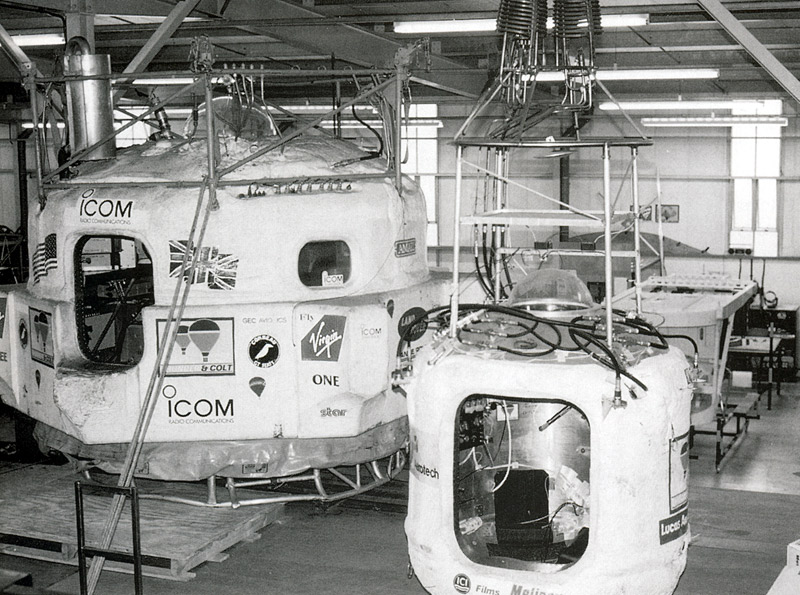
Family heritage. The Atlantic capsule rescued from the Irish Sea, dwarfs the Stratoquest altitude capsule.
The burners and solar gain should get the balloon up to altitude but getting it safely down again was equally crucial — particularly in view of the limited oxygen supply! As the balloon ascended so would the burning mid-summer Texas sun. Even with the parachute vent open the intense solar heating of the envelope could lift the capsule, now devoid of fuel weight, and keep it floating up in the upper atmosphere until the evening cool sent it back down to earth or sea. In this case the only way down would be to abandon ship and bale out with oxygen mask and pressure suit activated. Normally descent is controlled by winching open a parachute shaped vent in the crown of the balloon to spill out hot air. In case this wasn't sufficient to overcome the solar gain, an emergency "get you down" system was needed. The method chosen was to blow two panels out of the top of the balloon with "Miniature Detonating Cord" (M.D.C.) which is normally used to shatter fighter canopies before ejecting through them. Tests proved that if the detonating cord was simply taped to the fabric and fired, it cut the material cleanly and heat sealed the edges.
From the 1st of June we were ready to launch the balloon from the flat, dusty rodeo arena area behind the ranch but not until the 5th was the weather settled enough. On that date we worked through the night and as the first hint of pink colored the horizon, we were ready for lift off. Per arrived ready to go, after breathing pure oxygen for three hours to clear the nitrogen from his blood to prevent the bends. Suddenly a tremor ran through the balloon and it started to cavort around, tugging and pulling at the wood launch platform and anchor stakes. A dawn breeze had caught us on the hop. All hands leapt into action and the delicate balloon came down intact—it was a close shave. Next time we must launch before first light.
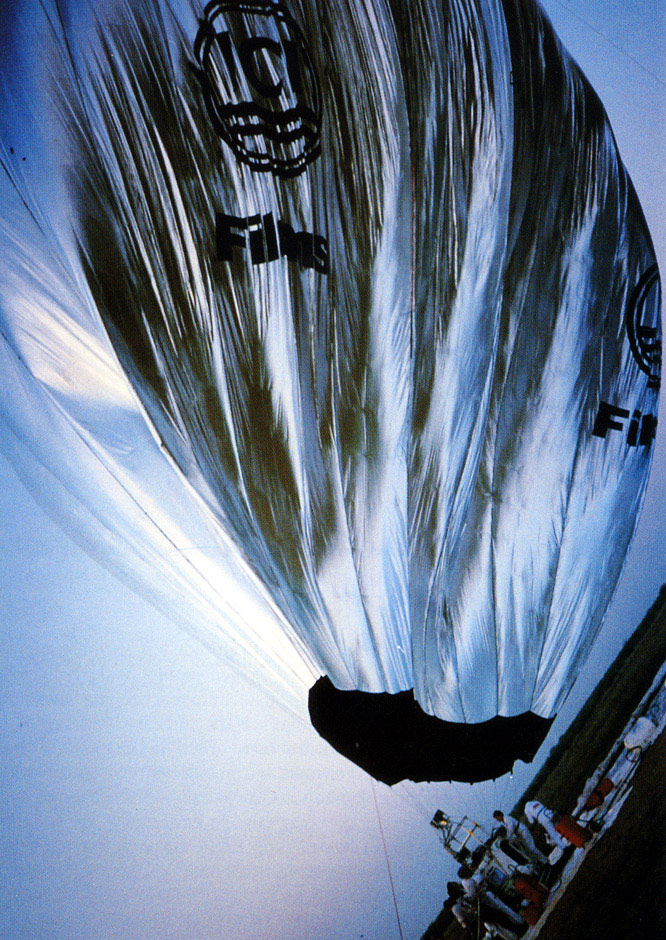
Stratoquestgets caught by a desert wind at dawn. The envelope is thrashing around while the crew hold the capsule down. The envelope was saved to fly successfully on the next day.
The next night the performance was repeated. The envelope was laid out before midnight, the inflation got underway at 3:30 a.m. and by 5:00 a.m. the balloon and capsule were upright and stable. This time there was no going back — Per climbed in and we were ready to launch. Per fired the burners to get some lift in the balloon and the simple wooden launch frame started to twist and creak ominous- ly. the local heavy gang helped to restrain the heaving capsule while the twisting linchpins were removed and the sandbags freed, but even the heavyweights were beaten, for as the pins were pulled, the balloon broke free with two sandbags still hanging on. The attempt was on, impeded by 200 lbs. of deadweight. Straight up into the darkness went the silver balloon illuminated by the burner like a halo around the capsule. As the balloon rose the crews' spirits fell — had we ruined Per's chances by not getting him away cleanly? The balloon continued to climb vertically above the base camp and crew. We dared not radio Per the go ahead and cut the bags loose for fear of being bombed.
Not until it reached 20,000 feet did the balloon drift clear of the ranch so Per could take off his oxygen mask and clamber out with his Swiss Army knife to cut the bags free. We prayed that he had not burnt too much fuel lifting the bags. Free at last the balloon continued its fiery climb into the oncoming dawn. At about 30,000 feet it broke into sunlight, a spectacular silver droplet trailing a haze of white condensation. Through binoculars we saw first one, then another fuel tank drift down on their parachutes—time to leave base and start the chase.
Take-off had been at 5:44 a.m. At 7:11 a.m. Per announced he was over the top and descending. The dome was iced up and he was flying his tiny cell by instruments alone. Down to 42,000 feet and the rising sun took over — the balloon levelled out — "Firing the M.D.C." crackled the message — it worked and the balloon continued its descent.
At 9:18 a.m. Per landed—not in the thorn scrub we dreaded but in the flattest, softest, gentlest field of new sown corn in the whole of Southern Texas. It was such a perfect landing that we could have fueled up and done it all over again.
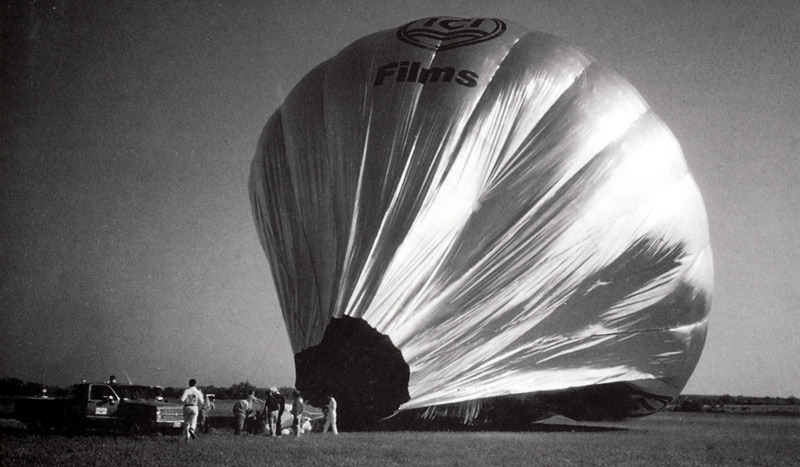
Stratoquest touches down in the softest field in South Texas.

"Stratoquest" desending over Texas after reaching a record 64,997 feet on June 6th, 1988.
The altimeter had frozen up at 59,700 feet so we had to wait for the sealed barograph to be read before we knew we had made it with a new record of 64,997 feet. The flight had taken 3 hours 34 minutes and the balloon had flown 70 miles from take-off to landing. See figure below. Apart from setting a world record we had taken a big step towards the Pacific crossing. We had proven that high altitude burners could take us into the jetstreams and we had highlighted some shortcomings.
Taking off with sandbags was becoming a habit and our basic wooden launch frames were obviously past their limit. We clearly needed a more sophisticated robust platform mounted on a turntable that could align with the wind. The capsule needed to be securely anchored to the platform itself with quick release fixings instead of sandbags.
Icing up on the visibility dome was inconvenient on a short duration flight, but on a long flight it would be unacceptable, so we would need a de-icing system.
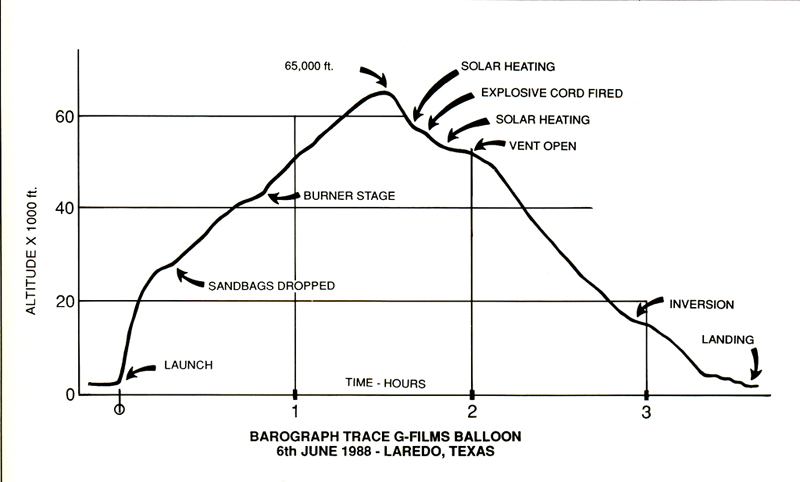
Stratoquest barograph trace.
Next Page


