
THE PACIFIC CHALLENGE ~ Chapter One
THE PROJECT
The ultimate ballooning adventure must be to fly around the world non-stop.
The long distance flights across the great oceans are milestones on the way, and represent major challenges and achievements. Pacific Flyer is the world's largest hot air balloon, designed specifically for the Pacific crossing from Japan to North America. It is the culmination of a series of long distance and high altitude balloons conceived by Per Lindstrand and built by Thunder & Colt in their Oswestry works near the North Wales border.
The author traces the lineage back through the successful but hair raising "Virgin Atlantic Flyer" and the high altitude record holder "Stratoquest" including the lessons learned from these projects. The Pacific Flyer evolved into a complex, high technology flying machine, equipped to keep the two man crew alive in their hostile, high altitude environment, and fly them over a huge lonely ocean, to land on an unknown site in unpredictable conditions. The problems, solutions and final successful design are described in the following chapters.
GETTING STARTED
"John, this is Per — we've got funding for the transpacific project — how soon can you start?"
"I'll be up in Oswestry next week Per!"
Was it me that said that? What is the irresistible attraction of these crazy projects? Living out of a suitcase, working all hours, on a tight budget, to an even tighter deadline, and at the end of the project you are out of a job and on your own, whether the project is a success or a failure.
As an "enthusiast" you'll not make a fortune, and as an engineer you'll not get the limelight unless you make a mistake and then every armchair expert in the business will tear you to pieces with the knowledge of hindsight. But who could resist the engineering challenge, the camaraderie of a small, dedicated team, the freedom to make decisions and carry them out, watching a high tech record machine grow under your eyes, and the excitement of the actual attempt, culminating in the despondency of failure or the euphoria of success.
THE CHALLENGE
What is the motivation to break records, and venture beyond the known boundaries with all the attendant risks? This inner driving force has been behind man's very development, it has inspired explorers, inventors, and adventurers leading to progress from the discovery of America to transplant surgery and the exploration of space. For better or worse, man must push out the limits, and each new step has required vision, conviction, and the courage to take risks.
The Pacific Flyer is about two men and their ambition to fly a hot air balloon further and faster than ever before. The men are Per Lindstrand, managing director of Thunder & Colt and Richard Branson, chairman of the Virgin Group.
Their objective was very simple:
TO FLY ACROSS THE PACIFIC IN A HOT AIR BALLOON AND LAND SAFELY ON THE OTHER SIDE.
To succeed the balloon had to harness the natural forces of the sun and jetstreams, so meteorologists were vital for predicting just the right weather window to launch it into perfect conditions. The balloon had to be controllable to keep it at the optimum altitude. The navigation aids and instrumentation must accurately locate the balloon and indicate its performance. Good communications were essential to keep the crew in touch with the outside world, especially the weathermen, and search and rescue services. In an emergency all the equipment must be on hand and work reliably. The performance predictions must ensure sufficient fuel to cross the ocean, but not so much that the balloon is carrying dead weight. Finally, a little bit of good fortune is essential — especially if two fuel tanks are accidentally dropped into the ocean on the way!
MEN AGAINST THE ELEMENTS
The Pacific is the world's largest and loneliest ocean, and to cross it as quickly as possible it was decided to ride across on the jetstreams. These high altitude winds circle the globe from West to East, and are at their strongest above the subtropical belts North and South of the Equator. This made for a flight path from Southern Japan to the coast of North America stretching from California to Canada. To reach the invisible jetstreams, and overfly the weather, the balloon had to fly between 27,000 and 36,000 feet, equivalent to the cruise altitude of passenger jets. At these altitudes the outside conditions are definitely unfriendly, with temperatures down to minus 55°C, and air pressure a quarter of sea level with a corresponding lack of oxygen.
To survive these ratified sub-zero temperatures it was necessary to enclose the two adventurers in a pressurised gondola or capsule, and supply them with compressed, warmed air to keep them alive. The inside of the capsule was pressurized to produce an artificial atmosphere (or cabin altitutde) of 8,000 to 10,000 feet so the pilots could operate comfortably, without oxygen masks. Apart from decompression and intense cold other natural hazards had to be avoided en route.
The jetstreams can be erratic and the right moment must be chosen to pick up a jetstream that is both fast and true. Fast enough to reach land before the fuel runs out, and true enough to take it to its chosen West coast destination, and not to veer off towards the tropical mid ocean or, worse still, to the deadly frozen North. Thunderstorms, though rare in winter, can still occur over the Pacific stirring up great columns of turbulent air to 40,000 feet or more. We relied on weatherman Bob Rice to choose the moment and guide the Flyer safely across. He has unparalleled experience in predicting the conditions for major ballooning events and got it just right for the Atlantic crossing. On the Pacific crossing the launch timing was influenced by political and financial considerations and two thirds of the way across the ocean the balloon was faced by a dividing jetstream with one fork heading south and into mid-ocean, and the other heading north towards Vancouver. Bob's decision to drop the balloon down in altitude and pick up the northerly stream worked beautifully — but the northerly stream turned out to be more northerly than either he or the pilots expected — as told in later chapters.
BALLOONING MILESTONES
Man has dreamed of flying since the beginning of history, and the dream was finally realized by two men in a hot air balloon on the 21st of November, 1783. Professor de Rozier and the Marquis d'Arlandes flew in a Montgolfier balloon made with a skin of paper and silk, and fuelled by burning straw and wool. Taking off from Paris they covered five and a half miles to the outskirts of the city. Only days later on the 1st of December, Professor Charles flew further and higher in a gas balloon filled with newly discovered and highly explosive hydrogen gas.
The first sea crossing was made across the English Channel in 1785. French balloonist Jean-Pierre Blanchard flew with his American sponsor Dr. John Jeffries from England to France in two and a half hours in their hydrogen balloon.
Ever since these early days over 200 years ago, ballooning has been associated with adventure and romance and there are still protagonists for both hot air and gas balloons for ultra long distance flights.
After nine previous attempts, many of them fatal, the Atlantic was finally crossed in 1978 by the helium gas balloon, Double Eagle II, launched from Maine to overfly Britain and land in France. Piloted by Maxie Anderson, Ben Abruzzo and Larry Newman, the balloon covered 3120 miles in 137 hours at an average speed of just under 23 miles an hour. Two more helium balloons followed; in 1985 American Joe Kittinger flew solo all the way to Italy and in 1986 a Dutch crew flew from Newfoundland to Amsterdam.
In 1987 the Virgin Atlantic Flyer became the first and only hot air balloon to cross the Atlantic, covering 3075 miles in 31 hours and 41 minutes, flying in the jetstream to become the fastest manned balloon with an average crossing speed of 97 mph and a peak of 153 mph.

Virgin Atlantic Flyer, crossing Nova Scotia
The first balloons to cross the Pacific were launched into the jetstream by the Japanese in the winter 1944/45. They carried bombs as a last ditch attempt to attack the American mainland and were found from Mexico to Alaska. Please see Video Page.
The first manned crossing of the Pacific was made in November, 1981 by Ben Abruzzo, Rocky Aoki, Ron Clark and Larry Newman in the seven and a half ton Double Eagle V helium gas balloon. The crossing from Japan to California covered 5770 miles and took eighty four and a half hours at an average of 68 mph. Flying at a mean altitutde of around 16,000 feet, it passed below the core of the jetstream and through some dubious weather.
Eight years later to the month the hot air balloon "Pacific Flyer" set out to challenge their record, but after an aborted launch with a damaged envelope, their record was safe for one more year. In November, 1990 the Pacific Flyer team was back again determined to fly faster and further than ever before.
FINDING THE FUNDING
Once the concept stage of a project has been firmed up, funds are desperately needed to get the project underway. Sufficient start up funds can produce a cheaper overall cost, as the investment possi- ble in manpower and materials can lead to an earlier completion date. Funding for adventure projects is generally from sponsorship linked to publicity. Both the Atlantic and Pacific Flyers were sponsored by Virgin Atlantic Airways to promote their transatlantic and Japanese flights. The resultant publicity was greatly enhanced by having Virgin's chairman Richard Branson himself as an active participant as co-pilot of the balloon. Unfortunately, the Pacific flight was overshadowed by the Gulf War which broke out while it was in mid-flight, so this remarkable and historic flight did not get the publicity it deserved — to repeat a quote "Ten out of ten for achievement, one out of ten for timing"!
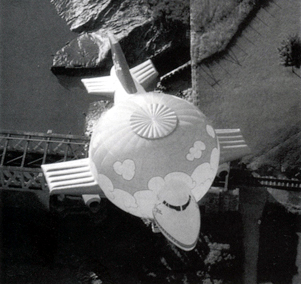
A "Special Shape" balloon. The well known GUMBO was built by Thunder and Colt to publicise Virgin Atlantic Airway and helped to introduce Richard Branson to ballooning.
THE FLIGHTCREW
The key members of the team are the pilots, Per Lindstram and Richard Branson. They already had the Atlantic crossing under their belts and have shared their baptism of fire (or water) in the Irish Sea. That they came back undaunted for an even more hazardous flight says it all.

"High Flyers" - Richard Branson and Per Lindstrand take time off from running Virgin and Thunder and Colt to fly the Pacific.
Per is the instigator of the project, initiating the concept and providing the technical expertise and manufacturing facilities of his Thunder and Colt balloon and airship factory. His experience as a fixed wing and balloon pilot makes the flight both feasible and credible to sponsors. Richard is chairman of the Virgin Group and Virgin Atlantic Airways. He started ballooning after ordering the famous Jumbo jet special shape balloon to publicize his airline. He is now a qualified and experienced pilot and has sponsored the two biggest and most ambitious hot air balloons ever. The resources, influence and travel facilities of the Virgin Group are invaluable when it comes to negotiating permits and arranging travel.
THE TEAM
Having established the concept, flight crew and funding of the project, a team had to be assembled. Thunder and Colt facilities were used to build the balloon and capsule, using many of the regular staff from whom the ground crew were drawn. Various specialists including engineers and the vital meteorologists made up the rest of the team. This team works together under extreme pressure, and soon builds up a camaraderie, and a special brand of humor. Every member is an expert in his own field and has the respect of the others — not that they would ever let it be known! There is a constant banter with nothing and no - one sacrosanct, humour not anger being used to relieve the tension.
- FLIGHT CREW: Richard Branson Virgin Atlantic Airways, Per Lindstrand Thunder & Colt
- GROUND CREW: (Japan) Project Engineer: John Ackroyd
- Paul Dickinson: Chief Balloon Inflation
- Jules Wigdor: Co-ordinator
- David Gill, Keith Goffin: Engineers Envelope
- Alex Ritchie, Jo Hanson: Engineers Engine & Pressuration
- Simon Forse: Engineer Burners
- Tony de Roy, David Marr: Engineers Electrics & Avionics
- Malcolm Humphrey, Colston Worrall and Dewi Williams: Engineering Support Team
- Paul Nicholson, Dennis Goodwin: ICOM Radio Operators
- Tom Abe: Japanese Liaison
- Belinda Currie: Team Support
- Paul Head: Weather
- RETRIEVE CENTRE: (San Jose, USA) Paul Woessner: Flight Controller
- Mike McDonald: Communications Engineer
- Doc Wiley:Search & Rescue, Co-ordinator
- Bob Rice: Weather
- Jim Senna: Weather Assistant Meteorologist
- Jim Mitchell: PR & Media Link
- Coy Foster: Chief Flight Surgeon
- Bob Gormley: HF Consultant
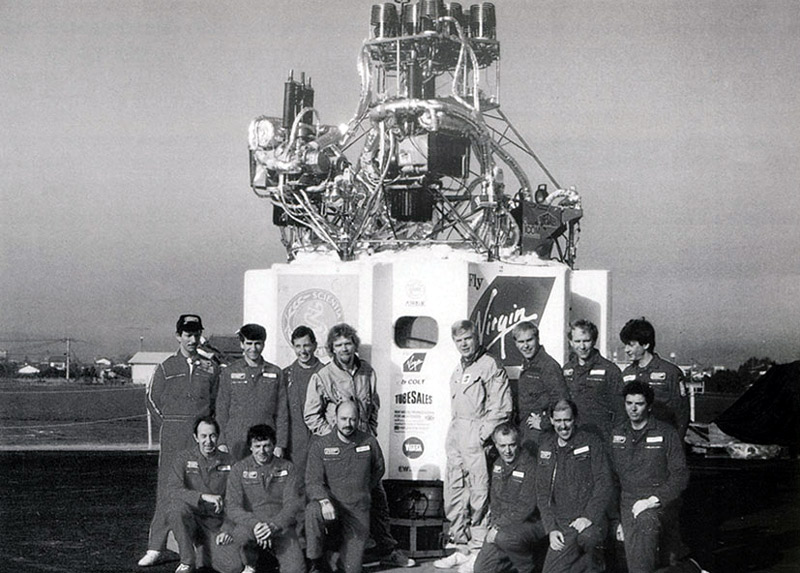
The Launch Team in Japan
Back Row: Paul Dickinson, Colston Worrall, Dewi Williams, Richard Branson, Per Lindstrand, Joe Hanson, Simon Forse, Dave Gill.
Back Row: John Ackroyd, Keith Goffin, Tony de Roy, Dave Marr, Malcolm Humphreys, Jules Wigdor.
Alex Richie is notable by his absence.
Although they were fortunate enough to be in on the flight, this team was only the tip of the iceberg. The balloon owed its existence to hundreds of people behind the scenes.
All the staff at Thunder and colt were involved in one way or another, particularly the girls who sewed the vast envelope (and left their knickers tied to it with good luck messages), and Tony and Keith who sculptured metal as fast as the author could draw it. Tremendous support was given by industry, and suppliers who produced parts and services in record breaking time. Virgin Airline staff got the balloon and capsule transported to Japan without a mark, and flew the team in comfort and style. The local population from Miyakonojo supported the project in spirit and kind, with construction equipment, engineering services, and happy, willing manpower — not to mention hospitality.
DEADLINES AND CLIFFHANGERS
"Deadlines" stop projects going on forever, getting too elaborate, and costing the earth. They are closely related to "Cliffhangers" which inevitably precede deadlines due to prevarication, late deliveries, and a whole army of bugs, and snags that lurk around waiting to sabotage a good deadline. These delays are only vanquished by liberal application of "midnight oil" at the last minute.
Technical adventure projects frequently challenge the elements, and must catch the most favorable natural conditions so there is usually a seasonal "weather window". This window normally sets the "deadline" and missing it can mean a whole year's delay and expense. The deadline for the Pacific Flyer was to be on site to catch the jetstreams at their fastest and most direct.
CROSSING THE OCEAN
CHOOSING THE ROUTE
The route had to follow the track of the jetstream flowing over the subtropical Pacific from West to East. In winter this track lies approximately along the 30th parallel. The nearest western seaboard below the path is the Southern Island of Japan — Kyushu — so it was here that we sought a launchsite. The track Could range from Alaska to Mexico, though we intended to select a stream that would give us a landing area from Oregon to California.
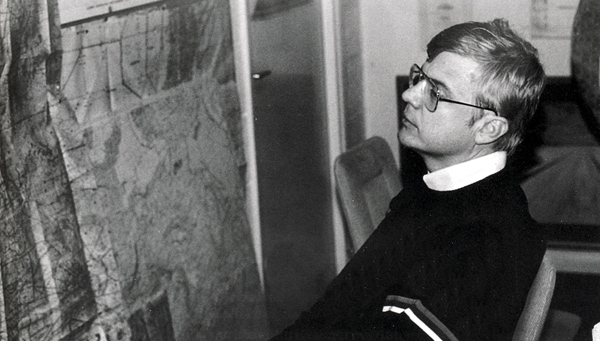
Per choosing a route across the Pacific.
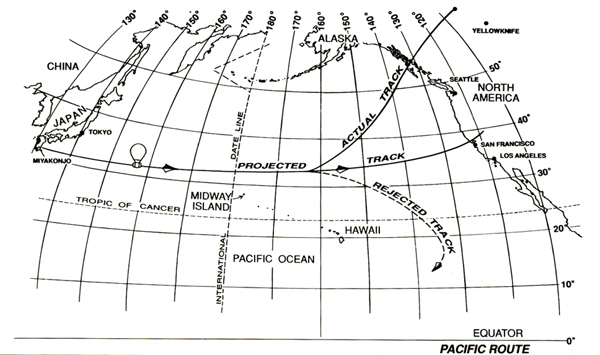
The transpacific route.
BASEBALL ARENA — THE 1990 LAUNCHSITE
The first foray to find a suitable site in Kyushu was made by Crispin Williams of Thunder and Colt, and "Tom" Abe, the T & C agent in Japan. With Crispin's ballooning experience and Tom's local knowledge, they homed in on Miyakonojo, the most southerly town likely to have the access and facilities we needed. The local town council enthusiastically welcomed the idea and offered all the help and hospitality one could hope for. The site Crispin and Tom were looking for would have to be flat and large enough to lay out an 80 metre long balloon, with good road access and service facilities, and be in a calm sheltered position.
The town suggested their baseball pitch. This proved to be at the dead end of a good but tortuous road, and provided all the flat space and facilities we could ask for, cut into a sheltered bowl on a hillside. It looked ideal and was selected as the provisional site.
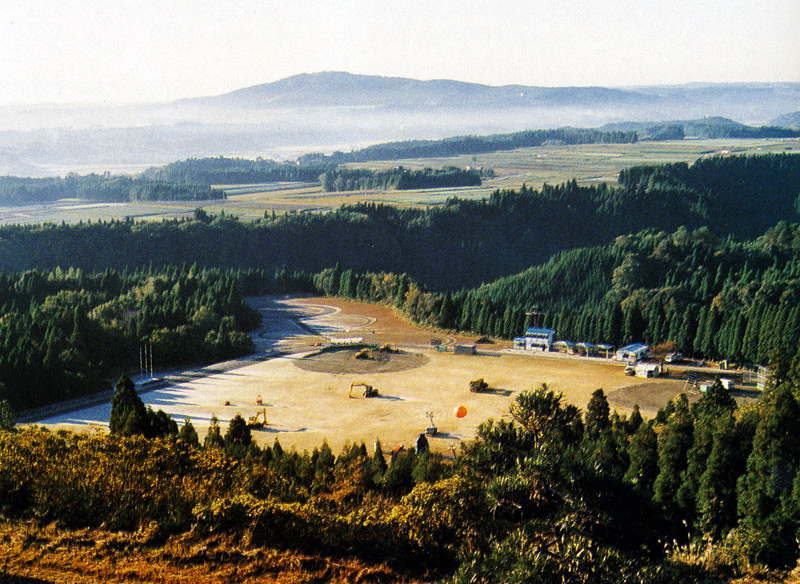
The launchsite. Miyakonojo, South Island, Japan
The capsule is in the nearside of the baseball pitch.
Jules Wigdor followed up the previous visit to confirm the site and was at once made at home and offered all the help he could ask for from the locals, who were even willing to dig a launch pad into the middle of their own baseball pitch. A local construction company proffered all the equipment such as cranes and forklifts that we would need. The deal was clinched and Miyakonojo it was.
To cap the deal, Jules found Sekinoo campsite — a collection of wooden huts and a cafe—set in golden autumn Japanese maple woods on the banks of a boulder strewn river and waterfall — a Japanese summer holiday village. It was the ideal place for the technical team, friendly and relaxing, away from all the hustle of town and the media — also perhaps it kept us on the job and out of trouble!!!
We made our own social life with barbeques and evenings in the common room — but did we freeze when it came to sleeping on the floor of those huts intended for summer visitors!
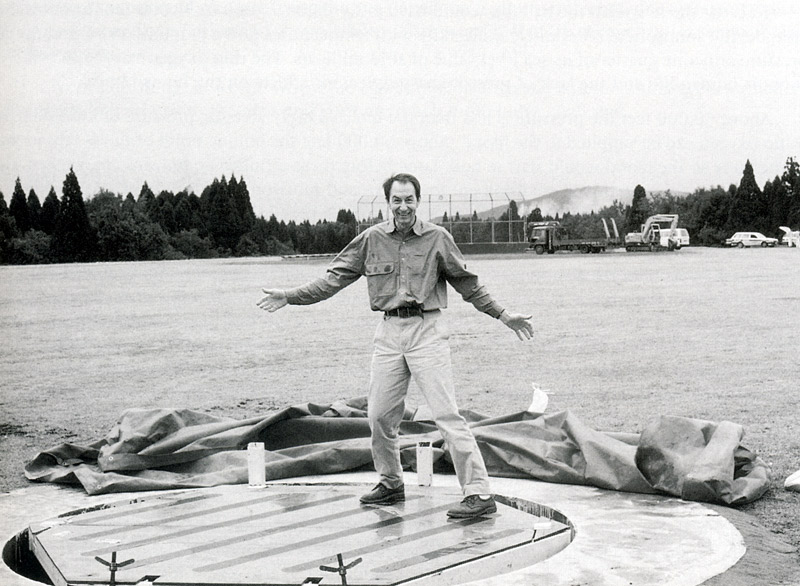
The launch pad.
CATCHING THE WIND — THE JETSTREAMS
Unlike an aeroplane, the balloon does not move through the air, but travels with the air that sur- rounds it. There is no relative movement between the balloon and its local patch of air so direction is adjusted by climbing or descending into different strata of air that are moving closest to the desired course. Low altitude recreation balloon pilots make use of ground features and local surface winds to influence their direction and control their balloons with amazing accuracy.
Long distance balloons, however, seek out the world's major air currents to carry them on their way. The subtropical jetstreams are the fastest and most powerful of these currents, the superhighways of the sky. They flow from West to East in two bands roughly over latitude 30° in both hemispheres. They are generated high in the atmosphere just below the tropopause at around 36,000 feet and are fastest and most concentrated in the winter season, forming a band approximately 200 miles wide by 2 miles deep. Speeds of over 200 mph can be experienced over Southern Japan, falling towards the American coast.
It is this jestream which the Pacific Flyer intended to catch, and it could carry the balloon along at an average speed of 100 mph or more — as we were to prove.
COLD AND THIN — THE ATMOSPHERE
To catch the jetstream the balloon would have to fly in the 27,000 to 37,000 foot level. At this altitude, the atmosphere is definitely unfriendly with temperatures down to minus 55° C and the air pressure only one quarter of its sea level value of 1013 millibars. The thin oxygen gen starved air will not support human life and the lack of pressure has unpleasant effects on the human body.
Above 50,000 feet the pressure is less than the internal body alveolar pressure of 116 millibars, so no oxygen can be supplied to the blood. Above 60,000 feet the boiling point of fluids falls to that of the body so the blood would start to boil. Long before these terminal conditions are reached, the body will require an artificial environment to survive and function. An altitude of 10,000 feet is a reasonable limit for a long flight and the Pacific capsule is pressurized down to this level. To provide the pressure and warm the incoming air, the outside air was compressed by an engine driven compressor, which also in turn supercharged the engine to keep it running at altitude.
DOWN TO EARTH — THE LANDING
The landing site is a big unknown. The hoped for area was the West coast of America from California to Oregon. Potential landing obstacles include built up areas, power cables, and mountain ranges such as the Sierra Nevadas. Beyond the Sierras are the sparsely populated high desert basins with large flats — these could be ideal.
The communication, control, and retrieve centre was set up in San Jose, south of San Francisco, and a mobile retrieve party was to set out from there to intercept the balloon as soon as its trajectory became defined. The distance the balloon would overfly the coast would depend on the crossing time.
Dawn is by far the safest landing time, being the calmest time of day, and before the sun starts to warm the balloon and fight its descent or create thermal conditions. It also gives the retrieve, recovery and reception party a full day's light ahead of them. If the fuel reserve, or terrain or weather do not permit a dawn landing, a less than ideal time may have to be selected. These decisions have to be made at the time by the pilots in consultation with the retrieve party.
Next Page


