
Chapter 5 - Stability and control
Stability
If a large powerful engine is installed in a lightweight low drag vehicle, something has to happen!
Exactly what this is depends on the degree of stability and control. The correct balance of these factors will enable the driver to realise the potential performance safely and predictably.
The performance required of a vehicle determines the degree of stability, manoeuverability and control demanded from it. "Thrust 2" requires great stability, little manoeuverability and precise control. It is a 'straight line' machine designed to reach a maximum of 650 mph over a measured mile. This mile lies in the middle of an approximately 13 mile course, giving acceleration and braking distances of 6 miles either end.
The inherent stability must not be so dominant that the vehicle cannot be controlled, or so marginal that it is oversensitive.
The overall stability is dependant on:
- aerodynamic stability — the shape,
- mechanical stability — the wheel to ground contact,
- weight distribution — C.G.(centre of gravity) position and polar movement,
- gyroscopic effects — engine and wheel rotation.
Control
At speed, control is limited to keeping the jet car 'on course', correcting for external influences such as side gusts, or track inconsistency. As a Land Speed Record car operates on a fixed plane, 'Mother Earth', the control is limited to:
- — acceleration — throttle,
- — yaw — steering,
- — deceleration — chutes and brakes.
When it comes to driver's controls, 'simple is safe'. To avoid confusion and reduce `thinking time', controls should be:
- — kept to a minimum, to fulfil required functions,
- — ergonomically placed, comfortable, easy to reach, simple to operate,
- — logically operated, following established practice.
Primary controls, control the vehicle 'on the move'. At high speed (1000ft each second) where every fraction of a second counts, it is essential that hands and feet are not removed from these primary controls. To make "Thrust 2" go, steer and stop the driver's primary controls are:
- — throttle — right footpedal,
- — brakes — left footpedal,
- — steering wheel with chute release buttons.
Secondary controls, such as switches and fuel cocks are operated before moving and after standstill.
The throttle system is cable operated through a modified Lightning fighter lost motion box. The throttle pedal progressively: opens hp cock, increases engine revolutions and selects reheat. The detent on the hp cock can be felt on the initial travel, further travel against spring pressure increases engine revolutions from idle to maximum; further travel still, against an additional 'step' in spring pressure, selects reheat. The pedal itself is large and has a 'toe pull' attachment so that the pedal can be positively pulled back should the normal spring return stick. When the pedal is fully returned, the foot can slide across on to a flush footrest to indicate full shut down and brace the driver in emergency.
The wheel braking system was undertaken by Lucas Girling Limited, under the direction of Glynne Bowsher. The brakes are hydraulically operated, using an electrically driven hydraulic pump.
The system pressure was adjusted to suit the widely differing friction coefficients of rubber tyres on tarmac and solid wheels on salt or mud. The pedal is large with an adjacent footrest as for the throttle.
The front wheel steering is controlled by a conventional steering wheel. As the movement is small, the wheel is elliptical to give more knee room, and instrument vision. Arm rests are fitted to the driver's seat to give support and more delicate control.
Two independant drag chute systems are fitted. The chutes 'fly' through the centre line but are stowed outboard, high speed to starboard and low speed to port. The chutes are deployed by 'thumb buttons' on the respective steering wheel spokes. The buttons are carefully located to require minimum hand movement for operation.
In the event of an accident, the emergency controls are: fuel cocks, battery master and fire extinguishers. The fuel cocks can be shut and fire extinguishers activated by one movement of the right hand, while the left hand cuts the battery.

Thrust 2: Behind the Wheel
Place mouse pointer over number for description of cockpit item.
Suspension and steering
The objectives of the suspension are to:
- provide a stable platform,
- keep wheel treads on the track,
- insulate car and driver from surface irregularities,
- impart good handling properties.
The most stable platform is achieved by placing the wheels at the exteme corners. This was achieved at the rear end of "Thrust" by mounting the wheels externally in the 'shadow' of the Kamm stern, where the wide rear track can directly react the roll moment from the fins. However, at the front this ideal situation cannot exist, for three reasons:
- the wheels must be aerodynamically 'faired in' so they must lie some distance behind the nose.
- For stability the C.G. must be well forward so a significant portion of the car weight must be forward of the front axle line. Fortunately this coincided with (1).
- The front and rear wheel tracks must be staggered so the rear wheels do not run into the front wheel ruts and cause the car to 'tramline'.
As the front wheels must lie inside the body envelope and still have room to swivel, the front track is narrower than the rear. Generally a large vehicle with a long wheel base will ride' the surface better than a small one.
The suspension geometry influences stability, control and steering.
All four wheels are set truly vertical (zero camber) with no camber change under travel as this would generate undesirable gyroscopic couples. The take beds are basically 'flat' without undulations but with inconsistent surface texture and ridges, so suspension travel is short at 11/2 inches bump and rebound, although more travel is available for emergency loading.
The rear suspension is by independant trailing arms. This layout ensures constant camber and track, with minimal wheelbase variation. The arms are fabricated from large diameter tubes to reduce deflection to a neglible level.
The front suspension is by unequal wishbones - the inequality being governed by kingpost inclination. Constant camber and negligible track change was achieved by converging the wishbone angles to operate on differing arc sectors to compensate for the unequal arms.
The springing is unconventional, but hollow rubber springs were selected for the following reasons:
- — high load capacity,
- — limited travel but sufficient for our application,
- — non linear rate, so resistance builds up roughly proportionally to aerodynamic download, keeping ride height more nearly constant,
- do not 'go solid' by bottoming under emergency loads,
- - fitted conveniently into available space.
Special low hysteresis, low creep rubber for otherwise 'standard' springs was developed by Malaysian Rubber. The springs are mounted between cups on the main suspension legs. The leg length can be adjusted so the suspension can be set to balance across each axle and eliminate 'rocking'.
Car incidence angle can be adjusted to increase or decrease downthrust by 'jacking' or `dropping' the rear legs.
The 'shockers' damp out the springing to stop the wheels from bouncing. At high speed on the flats they have to cope with high frequency low amplitude shocks, rather than the humps and bumps of everyday motoring, so they must act and recover rapidly. Road shockers are generally biased to give more resistance on the rebound stroke, but under lake bed conditions this could lead to 'pumping down' the suspension against the springs, so the shockers have been fitted with special valuing to give approximate 50/50 bump/rebound response. The shockers have also been set fairly 'soft' to allow rapid recovery and duplicated on each wheel to increase load capacity.
By definition, Land Speed Record cars should have four or more wheels and be steered by at least two of them. Additional aerodynamic rudder steering is also a possibility, with a transition from wheel steering at low speed to rudder control at higher speeds. Although it could be effective, this was not followed up for "Thrust" as it would mean 'breaking new ground' and lead to additional research and complexity beyond our resources. Traditional front wheel steering, which has been proven effective at over 600 mph was selected.
Rack and pinion steering has long been accepted in road and race cars but until "Thrust 2" had never been used in a Land Speed Record car. The advantages of directness, accuracy, compactness and geometric sympathy with independant suspension made it the natural choice. A beautiful quality heavy duty unit produced by Adwest for Leyland Engineering Limited buses, seemed to fit the bill. Adwest agreed to modify the length and stroke to suit "Thrust" geometry and remove the power boosting to increase the 'feel'.
The unit is nestled tightly in under the engine and rigidly secured to a massive cross member, to minimise compliance. The pinion is mounted centrally in the car. The shafting to it is in three universally jointed sections, the middle one running diagonally across the frame, so that in the event of an accident, it could collapse without penetrating the cockpit. The way a car handles is largely a product of suspension and steering characteristics. Handling is dependant on the following factors:
- self-centering effect — suspension geometry,
- oversteer, understeer effect— wheel cornering power,
- sensivity — steering ratio.
The steering is considerably effected by the front suspension geometry which controls the self centering' effect or tendancy of the wheels to return to the straight ahead position. As the Land Speed Record car is a straight line vehicle the 'self centering' effect should be Positive.
The controlling factors are: castor angle, kingpin inclination and kingpin offset.
The strength of the return action is also dependant on the weight on the front wheels as the inclined axes require the frame to rise as the wheels are turned. "Thrust 2" kingpin Inclination was largely determined by mechanical factors such as: clearing the brake disc, wheel rim crank, and kingpin offset. Castor angle has considerable influence on straight line running. Dragsters have extreme (up to 30°) castor but they are front end light to get maximum traction at the rear wheels.
"Bluebird", of a similar weight to "Thrust 2", ran successfully with 4° of castor, so it was decided to use this as an initial setting, but to have adjustment up to 6° on the upper wishbone legs. The original settings were found to give good control and feel on rubber tyres, but not to be 'positive' enough with solid wheels on salt or mud. Castor and offset have therefore been increased and the present geometric settings are as follows:
- — kingpin inclination —10°
- — kingpin offset — 2.2 inches
- — castor angle — 6°
- — toe in (inclusive) — 0° 20'
The steering ratio determines the sensitivity of the steering. A high (direct) ratio will give the driver more accurate 'feedback' from the front wheels but makes it more difficult to apply minute steering angles leading to a tendency to over correct - it is sensitive. A low (indirect) ratio is lighter to work, vague in feedback and leads to 'wandering' - it is insensitive.
A reasonably high ratio of 25 to I was chosen for "Thrust 2", this has given good results, both on rubber tyres and solid wheels.
For comparison, the ratios for previous Land Speed Record cars are:
- John Cobb's "Railton" — 12.5 to 1
- Donald Campbell's "Bluebird" — 32 to 1.
Oversteer is the tendency to exaggerate the driver's steering input - an unstable condition. Understeer tends to reduce it - a far safer and more predictable set up, especially when 'fine control' not manoeuverability is the objective. A vehicle understeers when the front wheels have less 'cornering power' (more slip angle) than the rear ones. On conventional cars this is affected by camber change and tyre pressure.
On "Thrust 2", there is constant camber so the slip angle is dependant on the wheel tread to ground reaction. This is a highly unusual case as the wheels are solid aluminium with a machined tread face running on a lake bed surface, the track being the compliant medium.
To achieve the required 'understeering' effect the front and rear wheels have differing `treads' with the rear wheels being 'keeled' to increase their cornering power relative to the front.

Thrust 2: Front Suspension

Thrust 2: Rear Suspension
Wheels
The surface of the flats is not 'rock hard' but has a degree of 'give'. This indicated that it would be possible to reverse the normal role and run a hard wheel tread on a compliant surface.
A 'solid' one piece wheel with no tyre promised several benefits, so the fact that no tyre company was prepared to develop or suppy Land Speed Record tyres, only clinched a decision that was already under consideration. The advantages of solid wheels are:
- — smaller and lighter,
- — size can be selected to suit car, not tyre,
- — no punctures, a serious hazard,
- — no tread loss, cause of imbalance,
- — cheaper to manufacture,
- — no vast stock of spare tyres required.
The disadvantage was the lack of data - we would be the 'guinea pigs'.
Wheel size has a bearing on several aspects of the car performance and handling. A smaller wheel can be packaged to fit in with the desired aerodynamic envelope, hence improving aerodynamic stability and reducing drag. In "Thrust 2" the front wheel lies ahead of the driver so a diameter of 30 inches was selected, giving him a reasonable angle of downward vision through the screen.
A smaller, lighter, wheel reduces the gyroscopic forces tending to overturn the car under extreme (loss of control) yaw conditions. A low unsprung weight ratio combined with independant suspension greatly improves ride and handling. The less the relative wheel mass, the less 'upsetting' force it imparts to the car and driver and the more it retains contact with the surface, doing its job, as the final link in mechanical stability. Due to the small size and unitary construction of "Thrust 2" wheels, the total unsprung weight has been kept very low at 9%. Low wheel weight also contributes to a lower overall and rotating weight, hence increasing the car's acceleration.
The choice of material for the wheel is dependant on its strength to weight ratio. Any given material has a diameter and speed limitation, after which its mass generates centrifugal forces beyond its strength, necessitating 'stepping up' to a more exotic material with higher strength/weight properties. With a wheel diameter of 30 inches and a speed limit of 8000 rpm (equivalent to 705 mph) we were fortunate to fall just within the limitations of aluminium alloy.
In order to balance the load between the two hub bearings, and to achieve the desired kingpin offset, it was necessary to crank the wheel rim inboard from the mounting flange. At speed, this crank tries to straighten up, imposing the maximum stress condition on the rim tip. Lucas Girling Limited kindly ran the stress contours on their computer. A physical proof test was also carried out by Rolls-Royce Limited, who spun each wheel to 8000+ rpm.
For strength and consistency the material chosen was forged L.77 having a strength of 29 tons/in' (440 N/mm2'). The blanks were hand forged by H.D.A. Limited and then fully machined from the blanks.The tread faces were impact peened to gain the following properties:
- — strength and fatigue resistance improved,
- — harder surface, better wear,
- — rough surface finish, better grip,
- — corrosion resistance increased.
Finally, the wheels were precision balanced.
The tread face takes ultimate responsibility for the car's mechanical stability. As already discussed, it critically affects steering characteristics. "Thrust 2" ran on solid wheels in 1981 and from the experience gained we evolved a second set for 1982 and 1983.
The original (Mark 1) wheels were designed to an academic analysis and element of 'intuition'. The rear tread was of shallow 'Vee' form with a central keel. The 'Vee' was selected to allow the wheel to 'plane' in a similar manner to a powerboat hull, and in case of loss of control to skid sideways without digging in and tending to 'trip' the car over. The keel was to give positive lateral location, for stability.
The front tread was of spherical radius with peripheral grooves (as standard aircraft tyres) for lateral stability but giving less positive cornering force than the rear keels to generate the desired `understeer' characteristics.
Handling the car on the salt at Bonneville with the 'solids' was expectedly 'different' from the driver's previous experience on tarmac with 'rubbers'. The control at low speed was less positive and tended to 'skate'. At approximately 240 mph the wheels came 'onto the plane' and control improved. Beyond this speed aerodynamic stability was increasingly effective and the car more precisely controllable. It was found that rapid initial acceleration through the low speed stage improved handling and the car ran arrow true up to 480 mph.
It must also be borne in mind that the runs were of very short duration, so the driver had only a total driving time of 12 minutes to develop a new driving technique for a unique situation.
The salt surface was softer than had been expected and as a result the ruts were cut deeper into it, meaning that we had to 'consume' track rather than re-use it. The effect of the salt consistency was that below 'planing' speed a ramp was being pushed ahead of the wheel, reducing effective castor angle and giving a natural braking action. The salt also 'stuck' to the wheels, until they were rotating fast enough to be self cleaning. After each run the salt had to be laboriously cleaned out of the tread grooves and slots to maintain correct wheel balance.
All the runs at Black Rock were made with the Mark 2 wheels. These are basically similar to the Mark 1 units but with refinements added from the lessons of 1981. The braking slots have been eliminated as they were not required and were tedious to clean out. The front wheels,which bear 64% of the vehicle weight, were increased in width from 4 inches to 6 inches to increase bearing area and reduce rut depth, and therefore hopefully increase understeer and reduce planing speed. New profile 'easy clean' peripheral grooves were incorporated. The rear wheels are identical except for the omission of the braking cross slots.
It is felt that once solid wheels have become 'optimised' and the driving techniques developed, they will represent a cheaper and more predictable option for Land Speed Record cars than pneumatic tyres with the ever present risk of a blow out.
Drag chutes
From 650 mph "Thrust 2" would roll for 8½ miles before coming to a standstill. This highlights the importance of the drag chutes, and their reliability. Quite apart from providing the 'normal' braking effort, the chutes can be used for emergency stabilisation, 'pulling on the tail' to restore loss of control, or in the case of an accident, holding the car straight to prevent tumbling.
"Thrust 2" is fitted with two chute systems, one for operation from 650 mph down (high speed) and one for operation from 375 mph down (low speed). At their deployment speeds both systems provide a drag of 22,000 lb effecting a deceleration of nearly 3g - to this must be added the vehicle's own drag deceleration.
The chutes are stowed in cylinders in the stern of the car, high speed to starboard and low speed to port. The chutes are mounted well outboard to pick up the slipsteam and are attached to a'self centering' hitch above the tailpipe so the pull acts through the centre-line. Both systems employ the same 7 feet 6 inch flat diameter ribbon chutes; a single for the high speed and a cluster of three for the low speed system. The chutes are packed in specially designed bags which are extracted by a small pilot chute, extending the 'tow line' before pulling out the canopy and allowing it to inflate.
The towline between canopy lines and car hitch is a vital element of the chute braking system. It must be long enough to allow the chute to fly in relatively undisturbed air, so it does not 'wag' the back of the car. "Thrust" towlines are l00ft for the high speed and 50ft for the low speed chutes. It must be strong enough to take the chute pull, plus the shock opening factor of 1.3 and cater for emergency opening above normal deployment speed. The lines are 32 mm diameter braided nylon rope with a strength of 48,000 lb and an elongation of 30%. The elasticity of this rope and the friction between the strands as it necks out', softens the opening shock and is kind to car and driver.
The chute deployment sequence is activiated by thumb switches on the steering wheel, this triggers a pyrotechnic launcher which propels a llb projectile rearwards and upwards from the back of the car. The projectile momentum pulls the flap release pin and extracts the pilot chute (drogue) from the cylinder, the pilot in its turn pulls out the bag and extends the towline from its mouth. When the towline is fully extended, it breaks a tie and releases the canopy from the second stage of the bag. A moment later the driver is hanging in his Straps as the canopy inflates. The launcher charge is detonated by duplicated circuits, one through the main 24 volt battery and one through a 9 volt dry cell powerpack, so even if the battery is disconnected the launcher will function.
Although it has a positive action, the firing button is always pressed twice to elinimate the time delay of a faulty action. This system proved to be totally effective and reliable during the Black Rock runs in 1982 and 1983.
The system described is that used for higher speeds on the lake beds and was tested and developed there since 1981.
For the UK runway trials we used larger lower speed chutes but these trials gave us valuable experience with deployment methods. We started with explosive guillotines cutting a textile cord and releasing a spring loaded pilot chute, but found that the cutter could miss a couple of strands and that the spring loading was not man enough to propel the pilot clear of the car. On one occasion the chute 'tucked into' the vortex and the car had to stop from 240 mph on wheel brakes alone. The car stopped 10ft from the end of the runway - but the discs were 'cooked!'
To improve things we developed our own compressed air launcher system, involving a compressed air bottle, a solenoid valve from a submarine, a launcher and various hoses. The system launched the chutes all right, but the high induced current from the solenoid tended to set off the fire extinguishers, the bottle needed recharging for each shot and loading the projectile was rather a 'delicate' and dangerous operation. While in the United States during our 1981 attempt, we were lucky enough to find the light simple aerospace launchers now fitted.
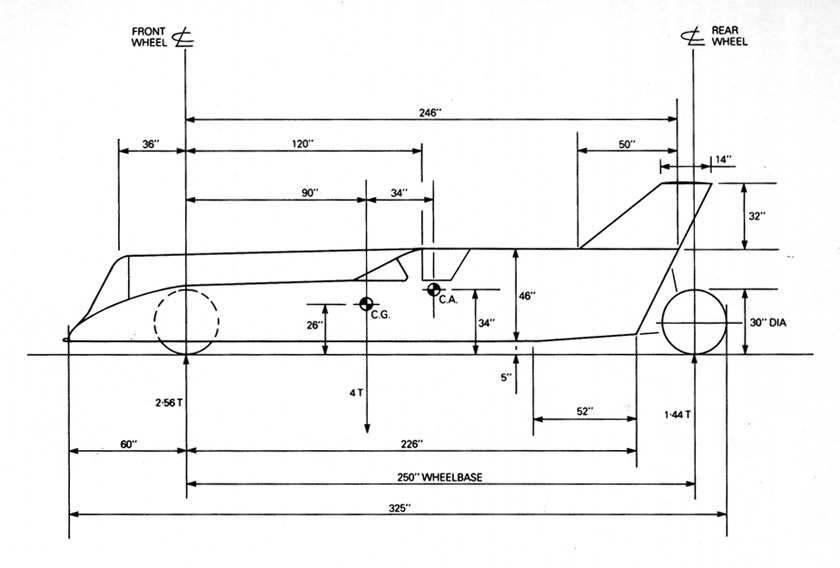
Thrust 2: General Dimensions
Weight distribution
Weight distribution affects both mechanical and aerodynamic stability. Laterial stability is assisted by having the C.G. (centre of gravity) forward of the mid wheelbase position, so the weight produces a restoring moment. The forward C.G. also keeps the front wheels loaded ensuring effective steering, and opposes nose up tendencies. For aerodynamic (weathercock) stability, the C.G. should lie ahead of the C.P. (centre of pressure). With a wheelbase of 250 inches and the C.G. lying 90 inches behind the front wheels, "Thrust 2" has a forward C.G. giving a weight distribution of 64% on the front wheels and 36% on the rear. Being a straight line machine it benefits from the positive lateral stability. Land Speed Record cars tend to be long and slender with the components 'strung out' in line. This produces high polar moments requiring greater upsetting forces to overcome the inertia and produce lateral movement. This 'damping' effect is beneficial as it gives steadier control: quite the opposite to that desired by sports car drivers who seek the rapid response engendered by the low polar moments of their mid-engined cars.
When rotating at speed, the engine and wheels produce a gyro stabilising effect. As the engine is run up to high rpm with the brakes on, the car has a 'reserve' of gyro stability before it moves off. Although beneficial when the car is running true, the couples produced in a turn (yaw) are detrimental, another reason to keep wheel weight and diameter down.
Aerodynamics
In order to get the Record, the car must have the required performance potential and the stability to realise it.
The performance is provided by having a margin of thrust over drag, the greater the the shorter the acceleration distance required. At the top end of the speed range, stability is predominantly aerodynamic, but control remains mechanical through the wheel steering.By the time the car is made it is too late to change its aerodynamic properties, so advance information is essential. A prediction of performance and stability characteristics can be made by using models in a series of wind tunnel tests. Ideally, the majority of the test programme should be completed before cutting metal. However, wind tunnel testing is an expensive business so a complete programme was beyond our early resources. Also to maintain commerical interest (sponsorship) it was necessary to produce some visible hardware as this is more 'convincing' than words and paperwork. It was therefore decided to proceed as follows:
- (1) draw a 'General Assembly' of the proposed Record car,
- (2) make preliminary wind tunnel tests to establish feasiblity of proposal,
- (3) manufacture skeletal car and run in this intermediate state to prove mechanical principles and raise further sponsorship,
- (4) undertake moving ground and transonic tunnel testing to prove and refine final shape and features,
- (5) construct outer shell to test results and complete car to Land Speed Record standard.
Using a space frame chassis gave us a rigid structure for the intermediate trials with minimum commitment to final configuration.
Between the intermediate and final configuration, an uprated "Mark" of engine became available and the opportunity was taken to fit this and raise the thrust/drag margin.
The first move, once the layout of the car was drawn up, was to make a tenth scale model for the preliminary tests in the British Aerospace low speed wind tunnel at Bristol. These tests were to forecast the drag, lift and stability of the car and study the effect of incidence, yaw, fins and wings.
Drag and stability were within the bounds required for the Record. Negative lift or downthrust was high and concentrated on the front wheels. The experimental horizontal wings were ineffective at high incidence angles and additional downthrust was not required, so they were dispensed with. The fins proved to be a necessary part of the yaw stability. Having established that the basic design of the car had record potential work was started on manufacture which consumed all our efforts and resources until roll-out of the car in its intermediate Avon 210 powered build state. Trials at this stage proved the systems and handling of the car on aircraft runways and culminated in taking the British Land Speed Record. The success of the trials maintained the confidence of our sponsors who continued their backing.
In October 1980 the car was returned to the workshop for the winter. In this time we had to transform it into a finished Land Speed Record contender. This involved designing and making solid wheels, changing the engine, establishing the skin profiles and constructing the body.
Before starting the next series of low speed tests, the transonic implications were discussed at British Aerospace, Weybridge, who were going to undertake the high speed tests. They recommended a curved transition between nose wheel arch top radii (prolate to spheroid form) and a larger radius over the canopy to soften the 'shocks' generated in these areas. These recommendations were incorporated into the low speed model. At the same time interchangeable underbody configurations were made and pressure tappings inserted into the upper and lower sidebody surfaces.
In order to study the underbody effects more realistically, it was decided to make the tests in a moving ground tunnel. These are few and far between and in demand from the Formula 1 teams but a slot was found in the Southampton University facility. These tests closely followed the preliminary results. Drag and stability were acceptable, but downthrust on the front wheels was high, being a product of the venturi effect under the car. To reduce the downthrust and distribute it more evenly front to rear, three aspects were investigated:
- (1) underbody configurations — flat bottom, upswept rear, radiused corners and boundary members,
- (2) ground clearance,
- (3) angle of incidence.
The tests showed that upsweeping the rear underbody balanced the front to rear loading, decreasing ground clearance, reduced downthrust and drag. Angle of incidence had a considerable effect on downthrust. Positive (nose-up) incidence reducing it to zero at 2' (aerodynamic balance) and counter-acting the weight restoring moment at 3° (divergence). Due to the long wheel base, these angles represent significant movement at the front wheels so the sensitivity was not alarming.
The high speed tests were carried out in the British Aerospace, Weybridge, transonic tunnel. The model size selected to suit this tunnel was a thirtieth and the model was machined from solid aluminium, duplicating the low speed model shape through a 3:1 pantograph machine.
The tests were carried out up to a Mach Number of .86 exceeding our target of 650 mph so the results reflected our ultimate performance and prospects of success.
A critical aspect was the transonic drag rise to be expected beyond 550 mph. In the event, this was not excessive and a predicted drag of 12,000 lb at 650 mph indicated an acceptable margin of thrust over aerodynamic drag.
The shocks over wheel arches and canopies were relatively subdued and did not shroud fin effectiveness. Downthrust showed a sharp increase after 550 mph but it was considered that this was due to the model mounting arrangement, later to be borne out by actual results which showed the reverse effect. The results coincided well with the preceding tests and confirmed yaw, incidence and ground clearance findings.
As a result of the tests it was decided to lower the car to a maximum ground clearance of 5 inches and a solid wheel diameter of 30 inches gave this.
The initial car incidence was set at 0° (zero) and downthrust monitored. In the event, the downthrust was negated by giving the car slight nose up incidence to reduce wheel drag. The profiles of the car were lofted to the model ordinates and the body structure manufactured as described in Chapter 4 - Structure.
Next Page


